Faraday Bags for Phones: What to Look For & Which Ones Work
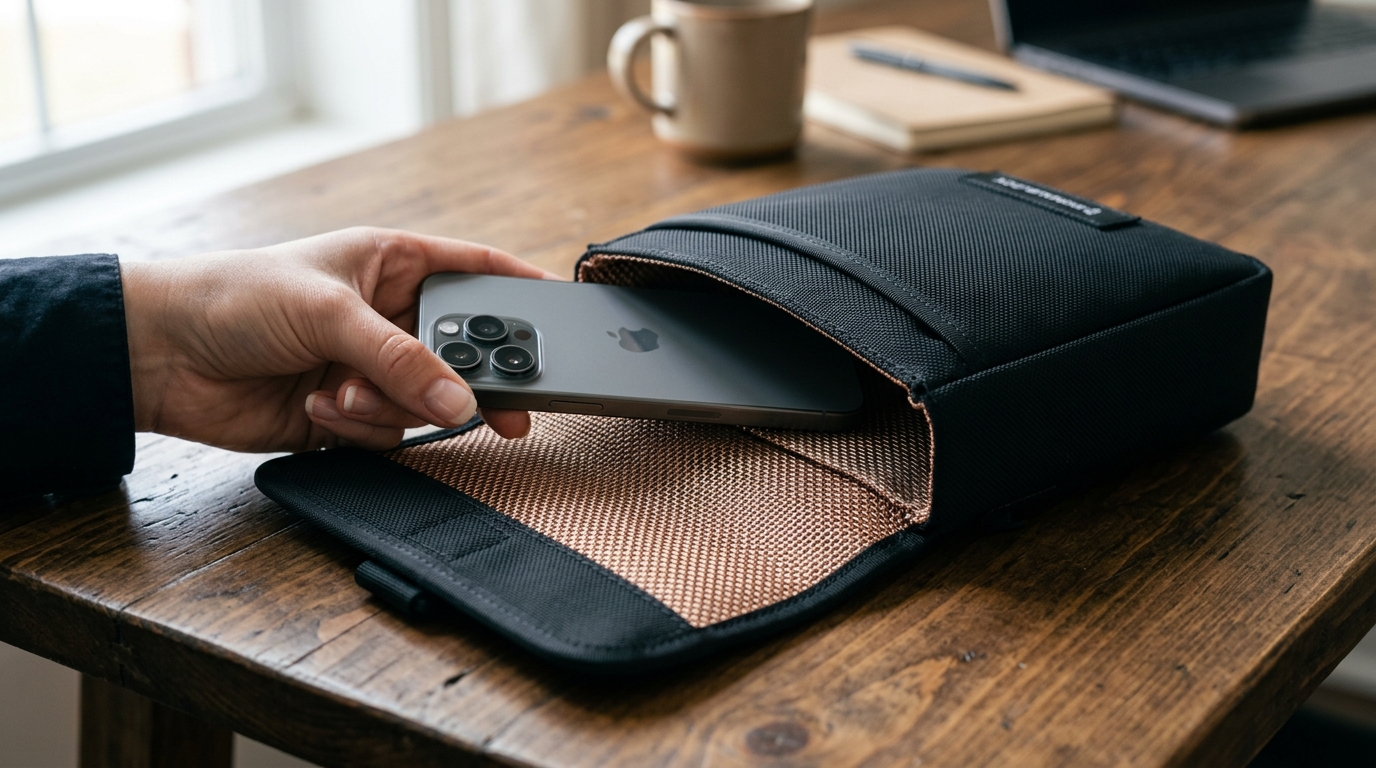
A Faraday bag for phones is a conductive pouch designed to isolate a smartphone from cellular, Wi-Fi, Bluetooth, GPS, and NFC signals while it's properly enclosed.
Unlike Airplane Mode, which is a software setting the phone's own operating system controls, a physical Faraday enclosure doesn't depend on the device's software state at all — it attenuates the signal at the fabric itself, regardless of what the phone thinks it's doing.
A phone uses several different radio systems at once, and whether a specific bag actually isolates all of them depends on its construction, closure, and condition — not on the label “Faraday bag” alone. This guide covers what actually matters when choosing one, and whether you need one in the first place.
At a glance // Phone Shielding Evaluation
What it's forPhysically isolating a phone from cellular, Wi-Fi, Bluetooth, GPS, and NFC signals.
What mattersClosure and seam continuity, stated attenuation figures (not just adjectives), and how the fabric holds up to repeated use.
What it doesn't stopAnything already stored locally on the device, or data collected before the phone was sealed — a Faraday bag isolates live signal, it doesn't erase or retroactively protect anything.
AlternativesAirplane Mode combined with powering the phone down, though this depends on the device's software behaving as expected rather than offering the same physical certainty.
// CURATED EVALUATIONS
Phone Faraday bags worth considering
A phone Faraday bag isolates cellular, wireless, and satellite signals simultaneously. Below are five verified options spanning forensic-grade enclosures, published decibel benchmarks, and multi-size sets.
01
PUBLISHES A FIGURE80 DB CLAIM
Simket 2-Pack Military Grade Faraday Bags
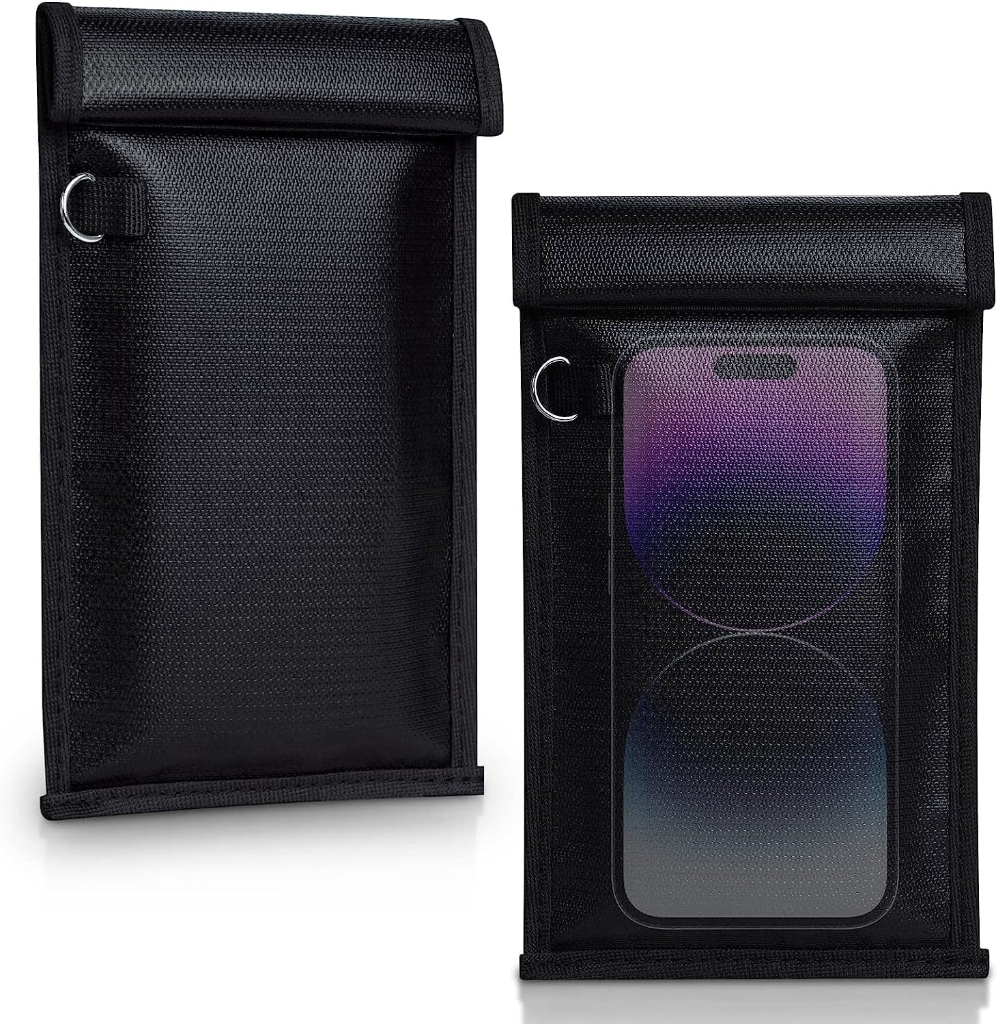
A two-pack of flexible signal-blocking sleeves measuring 7.8" x 4.3", designed for smartphones, key fobs, and cards. Simket stands out among budget multi-packs by publishing a concrete attenuation claim: "over 80 dB" across standard wireless frequencies. While this is still a manufacturer-stated claim rather than an independently certified laboratory test report, stating a decibel figure makes the claim falsifiable and testable — a meaningfully higher standard than vague marketing slogans.
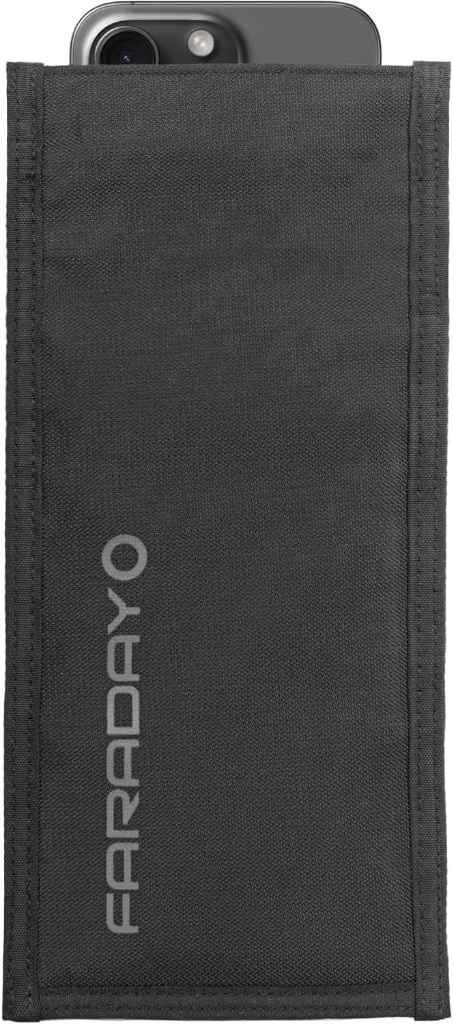
A law-enforcement and digital forensics oriented phone sleeve engineered around high-reliability radio isolation. Faraday Defense provides the most detailed technical specification in this batch: stating "-85dB attenuation across 400MHz to 4GHz" frequency bands. Built with heavy-gauge puncture-resistant CORDURA nylon and a magnetic quick-seal closure that avoids the fiber-fatigue and micro-gap leakage common in worn hook-and-loop velcro flaps.
WHAT WE LIKE
Heavy-duty CORDURA nylon provides high durability
States precise attenuation across frequency range
Magnetic seal closure ensures continuous contact
WATCH FOR
Substantially more expensive than generic multi-packs
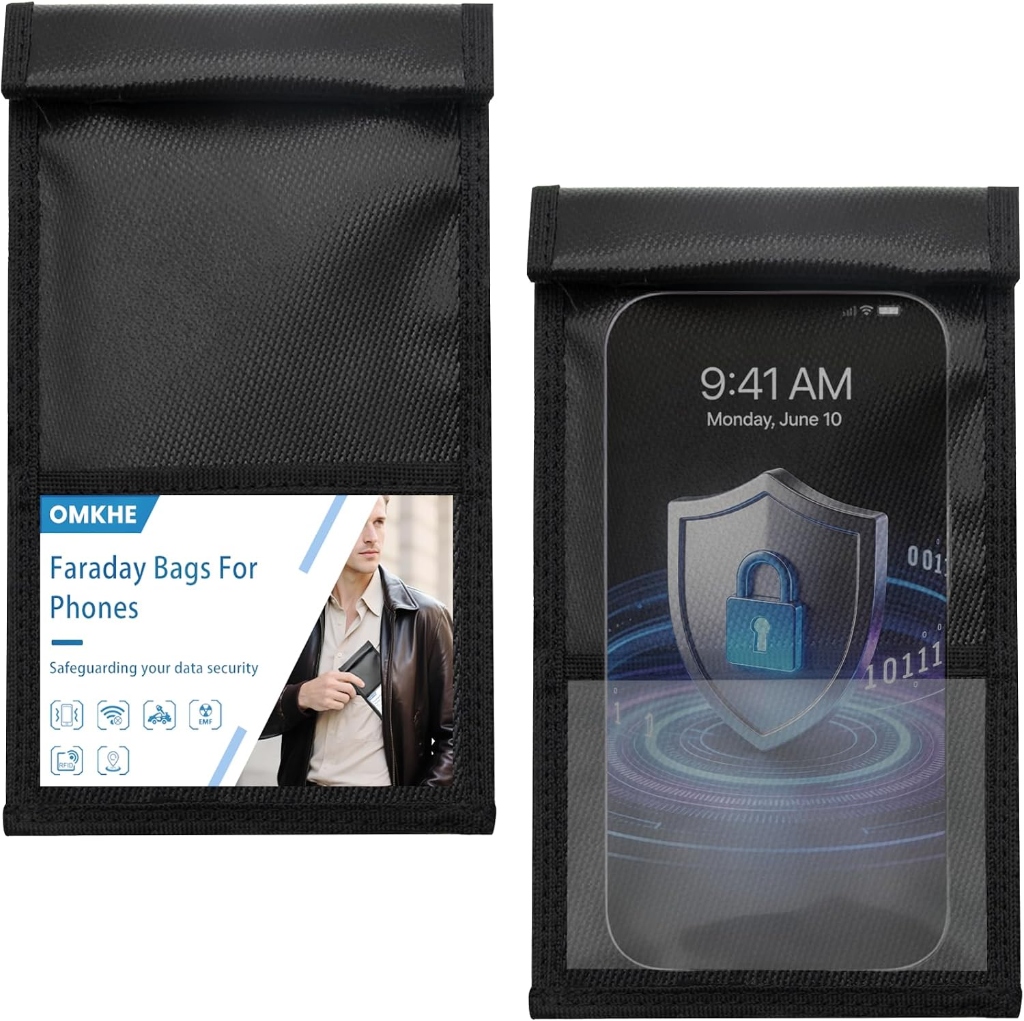
A two-pack of phone sleeves constructed from textured carbon-fiber PU with a double-roll hook-and-loop closure. The physical double-roll fold is mechanically sound, creating two distinct contact lines that reduce RF leakage through the opening. However, OMKHE’s listing prominently claims the bag shields pregnant women from harmful radiation — an unverified, fear-based marketing claim that PrivacyLabz explicitly does not endorse. The bag attenuates radio signals for phone isolation, but health-related shielding claims should be ignored.
WHAT WE LIKE
Double-roll closure reduces RF leakage risk
Sized to fit larger smartphone models
Affordable two-pack for primary and backup
WATCH FOR
Marketing makes unsubstantiated pregnancy health claims
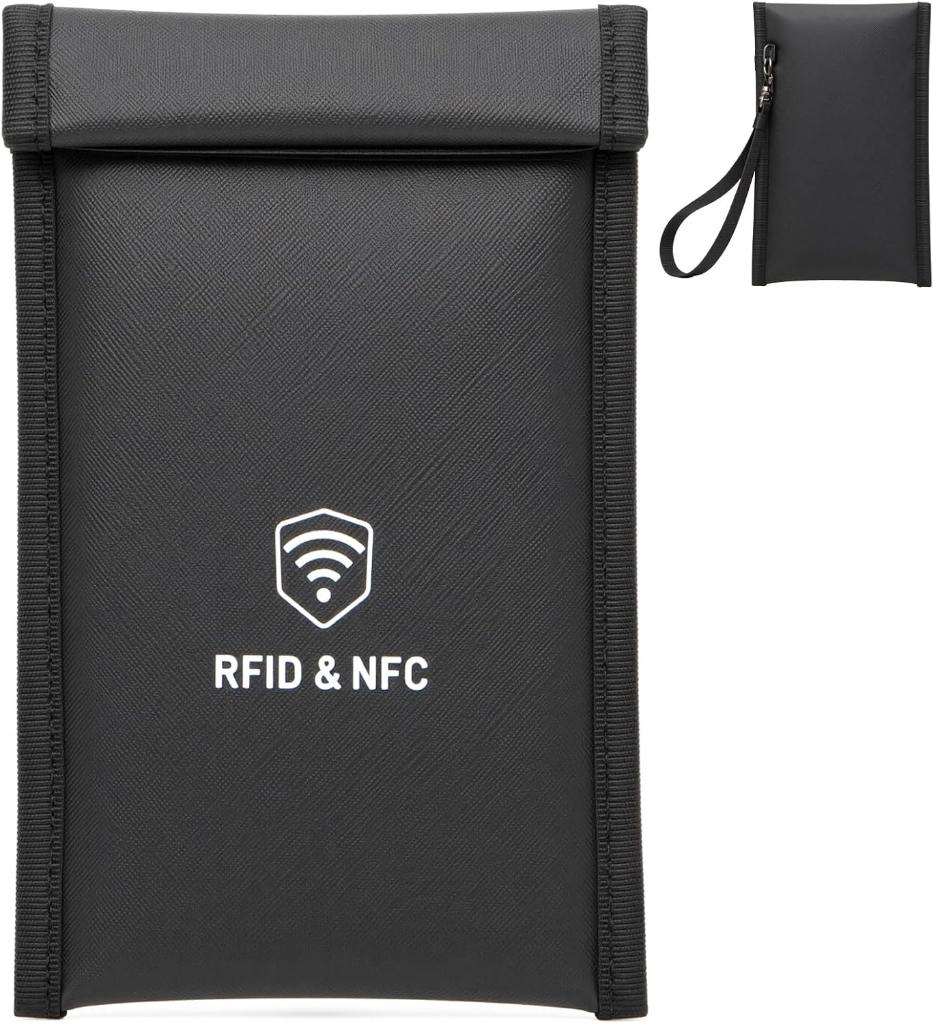
A compact phone pouch measuring 7.5" x 4.1" with a detachable wrist strap and textured synthetic leather exterior. XIAODUN’s marketing represents the classic unquantified claim pattern: promising "military-grade full-band signal shielding" and telling buyers to "vanish from the grid instantly," without citing a single decibel figure, frequency range, or test methodology. The physical pouch functions as a basic conductive sleeve, but its marketing language requires skepticism.
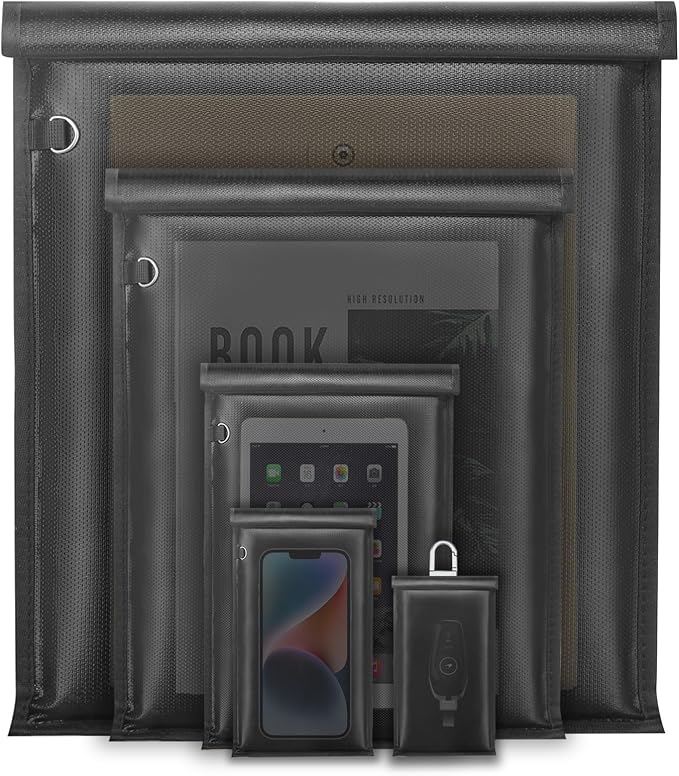
A multi-size 5-pack ranging from key-fob pouches to phone and tablet sleeves, featuring a transparent RF-shielded mesh preview window. The window allows users to confirm the screen is unpowered or check whether cellular bars drop to zero without breaking the seal. While convenient, adding an optical mesh window introduces an additional seam junction that can be more vulnerable to RF leakage than solid continuous fabric.
Affiliate Disclosure: PrivacyLabz may earn a commission from qualifying purchases. This does not affect the price you pay, nor does it influence our editorial evaluations. We have not laboratory-tested these products unless explicitly stated; specifications are cited from manufacturer disclosures and published technical documentation.
SOFTWARE TOGGLES VS. PHYSICAL ISOLATION
Modern smartphones treat “off” as a software state, not a hardware disconnect. Even in Airplane Mode, or fully powered down, some devices keep a low-power radio active — Apple’s own documentation confirms newer iPhones can continue broadcasting a Find My Bluetooth signal for a period after being switched off. A physical Faraday enclosure doesn’t depend on the phone’s software cooperating at all — if the signal can’t physically leave the enclosure, the device’s power state doesn’t matter.
What is a Faraday bag for phones?
A phone Faraday bag is a flexible pouch lined with conductive fabric — typically a metallized textile, often nickel- or copper-coated — enclosed in a durable outer shell. Its job is to attenuate the radio signals a phone sends and receives while it’s sealed inside.
It’s a different job than an RFID sleeve or wallet. An RFID product only needs to address one narrow frequency (13.56 MHz, the range payment cards and NFC use). A phone uses several distinct radio systems at once — cellular, Wi-Fi, Bluetooth, and GPS/GNSS reception, each in a different part of the spectrum — so a phone bag has to provide meaningful attenuation across all of them, not just one. That’s a genuinely harder engineering problem, and it’s part of why a bag rated well for phones isn’t automatically well-suited to a different device with a different radio mix.
How phone shielding works, and where it actually fails
The underlying principle goes back to Michael Faraday’s 1836 demonstration: a continuous conductive enclosure causes an external electromagnetic field to redistribute charge across the material’s surface, cancelling most of the field before it reaches the interior.
In practice, the fabric itself is rarely where a bag fails — the seams and closure are. Any gap in a shielded enclosure can behave like a slot antenna, letting radio energy through it directly rather than being blocked by it. This matters more at higher frequencies: 5 GHz Wi-Fi has a wavelength under 6 centimeters, so even a small, consistent gap along a seam can leak meaningfully more than the same gap would for a lower-frequency signal like cellular. This is why closure design — continuous contact along the full seam, not just a single fold-over flap — matters as much as the fabric quality itself, covered in more depth in Do Faraday bags actually work?
Claim Check
“Military-grade full-band signal shielding”
“Military-grade” isn’t a regulated term with a fixed meaning — it names no decibel figure and no tested frequency range. Real shielding standards exist (IEEE 299, for instance, defines a laboratory method for measuring shielding effectiveness across a defined frequency spectrum), and a brand that’s actually tested against one would generally cite the standard and the figure, not just the adjective. “Military-grade” on its own is marketing language, not a specification.
What actually matters when choosing a phone Faraday bag
01 // CLOSURE DESIGN
Continuous contact along seam
A closure that maintains continuous contact along its full length is more resistant to leakage than a single-fold flap — this is a mechanical property of the seam, not something a fabric spec alone tells you.
02 // STATED ATTENUATION
Real figures vs. total isolation
Look for a real figure — a stated dB attenuation tied to a frequency range — rather than an unquantified “total isolation” claim. Treat any figure as a manufacturer claim unless it’s tied to an independent test.
03 // FIT FOR YOUR PHONE
Room to seal with case
The device needs to fit fully inside with room for the closure to seal properly, case included if you use one — forcing an oversized phone into a bag that’s too small stresses the seam exactly where it needs to seal cleanly.
04 // WEAR OVER TIME
Mechanical fabric degradation
Conductive fabric is subject to real mechanical degradation. A peer-reviewed study found a measurable shielding-effectiveness loss after repeated stress cycles on conductive textile — the same general pattern applies here: a bag that worked well new isn’t guaranteed to perform identically after months of folding and use.
Do you actually need a Faraday bag for your phone?
For most everyday smartphone use, no — it’s more friction than the situation calls for. Airplane Mode, or simply turning the phone off, covers most ordinary needs (meetings, flights, focused work) without needing a dedicated product.
Physical isolation earns its place in narrower, real situations:
Digital forensics and evidence handling. Investigators use Faraday enclosures on seized devices specifically to prevent a remote-wipe command from reaching the phone before it can be examined — a documented, practical use case, not a hypothetical one.
Defending against passive location broadcasting. As covered in the editorial note above, some phones keep broadcasting a low-power Bluetooth signal even when powered off. A Faraday bag is the one method that addresses this regardless of the device’s software state, since it isn’t relying on the phone’s power state cooperating.
Travel through specific high-risk contexts. Not a default need for ordinary travel, but a reasonable precaution in specific situations — crossing certain borders, or environments where cellular network spoofing devices are a documented local concern.
Core Principle
Airplane Mode is a software setting. A Faraday bag is physical radio isolation.
They solve different problems — see Airplane mode vs. Faraday bag for the fuller comparison, including why Airplane Mode’s actual behavior varies more across devices than most people assume.
One practical note worth keeping: sealing an active phone into a bag can cause its cellular radio to work harder trying to maintain a connection, which drains the battery faster and generates some heat. Switch to Airplane Mode or power the phone down before sealing it, rather than relying on the bag alone to quiet an actively-searching radio.
Frequently asked questions
Do phone Faraday bags actually block 5G signals?
A well-built bag can attenuate sub-6 GHz 5G the same way it handles other cellular bands. mmWave 5G is a separate, higher-frequency technology that needs denser shielding to attenuate effectively, and general-purpose phone bags aren't automatically built or tested for it — see What do Faraday bags block? for the fuller breakdown.
Will my phone alarm still go off inside a Faraday bag?
Yes — alarms run locally on the device and don't need a network connection, so they'll typically still sound, muffled by the enclosure.
Does a phone drain its battery faster inside a Faraday bag?
It can, if the phone is still actively searching for a signal when sealed — the radio works harder trying to connect, which uses more power. Switching to Airplane Mode or powering off first avoids this.
Can a phone be tracked when it's powered off inside a Faraday bag?
If the bag is genuinely blocking the relevant signal, no — but as covered above, some phones retain limited Bluetooth broadcast capability even when "off," which is exactly the scenario physical shielding is built to address. Full detail in Can a phone be tracked inside a Faraday bag?
How long does a Faraday bag for phones typically last?
There's no universal lifespan figure, and stating one would be misleading. Shielding fabric degrades with repeated folding and wear — retesting periodically, especially if you're relying on the bag for something that matters, is more useful than assuming a fixed shelf life.
How can I test if my phone Faraday bag is working at home?
A basic call test (seal the phone, call it from another line) catches an obvious failure but only verifies cellular — full walkthrough, including Wi-Fi, Bluetooth, and GPS-specific checks, in How to test a Faraday bag at home
Sources Used
Apple — “Find My & Privacy” — Supports newer iPhones retaining limited Bluetooth broadcast capability after being powered off.
“Who Can Find My Devices?” (Heinrich et al., arXiv, 2021) — Supports the technical mechanics of Apple’s crowd-sourced offline-finding network.
“Durability of Shield Effective Polyester Cotton Fabric...” (Polymers/PubMed, 2023) — Supports measurable shielding-effectiveness loss after repeated mechanical stress cycles on conductive fabric.
“Designing an RF Shielded Enclosure,” Interference Technology and “Shielding: The Hole Problem,” Electronic Design — Supports seam/aperture leakage as the dominant real-world failure mode, and the slot-antenna model for calculating it.
Removed from the prior draft, not carried forward: the specific “500D ballistic nylon” material claim, “mmWave 5G up to 39 GHz” as a stated upper bound, and several closure-geometry specifics presented as settled engineering fact — none of these were sourced in a way that could be verified, and repeating them would mean stating more precision than the evidence supports.
Explore Faraday Protection by Device
Navigate our practical guides across each device shielding category: