The difference between marketing claims and attenuation
Many budget listings market their bags with absolute claims — “100% Signal Proof,” “Military Grade.” In RF engineering, no physical enclosure blocks every frequency with perfect certainty. Shielding performance is measured as attenuation in decibels (dB): how much a signal’s strength is reduced, not whether it’s eliminated entirely. Higher attenuation gets closer to fully silencing a connection, but “100%” isn’t a real engineering claim — it’s marketing shorthand for “we didn’t measure this.”
No shielding enclosure is described this way in actual RF engineering literature — performance is always expressed as attenuation in decibels at specific frequencies, because that’s what’s actually measurable. A claim with no dB figure and no frequency range attached isn’t a specification. It’s a slogan.
The seam and closure problem
In real shielding engineering, the enclosure material itself is rarely the weak point — the seams and openings are. Industry sources on RF-shielded enclosure design are consistent on this: aperture and seam discontinuities “account for most of the leakage in a shielding enclosure,” and the shielding effectiveness of an opening can be modeled using the same physics as a slot antenna — meaning a gap in a shield doesn’t just fail to block signal, it can actively radiate some of it through.
This is why closure design matters as much as the fabric. Continuous, direct metal-to-metal (or conductive-fabric-to-conductive-fabric) contact along the full length of a seam is what keeps leakage low; a single-fold velcro closure that doesn’t maintain that contact evenly across its length is a more likely leak point than a closure designed for continuous contact, such as a dual-fold or magnetic roll-top. Exactly how much a given gap leaks depends on its size relative to the wavelength of the signal — higher-frequency signals (like 5 GHz Wi-Fi) have shorter wavelengths and are generally more sensitive to small gaps than lower-frequency signals like a car key fob’s. This is also part of why frequency coverage isn’t automatic: a bag that reliably blocks one frequency range isn’t guaranteed to perform the same way at a much higher or lower one — closure quality that’s “good enough” for one signal may not be for another. The precise leak threshold varies by design and isn’t something a general article can responsibly reduce to one universal number, which is exactly why a bag’s actual tested performance matters more than assumptions about “how good the fabric feels.”
What this looks like in real listings
The gap between a real specification and a marketing slogan shows up directly in how products are actually sold. Two examples, both currently listed on Amazon:
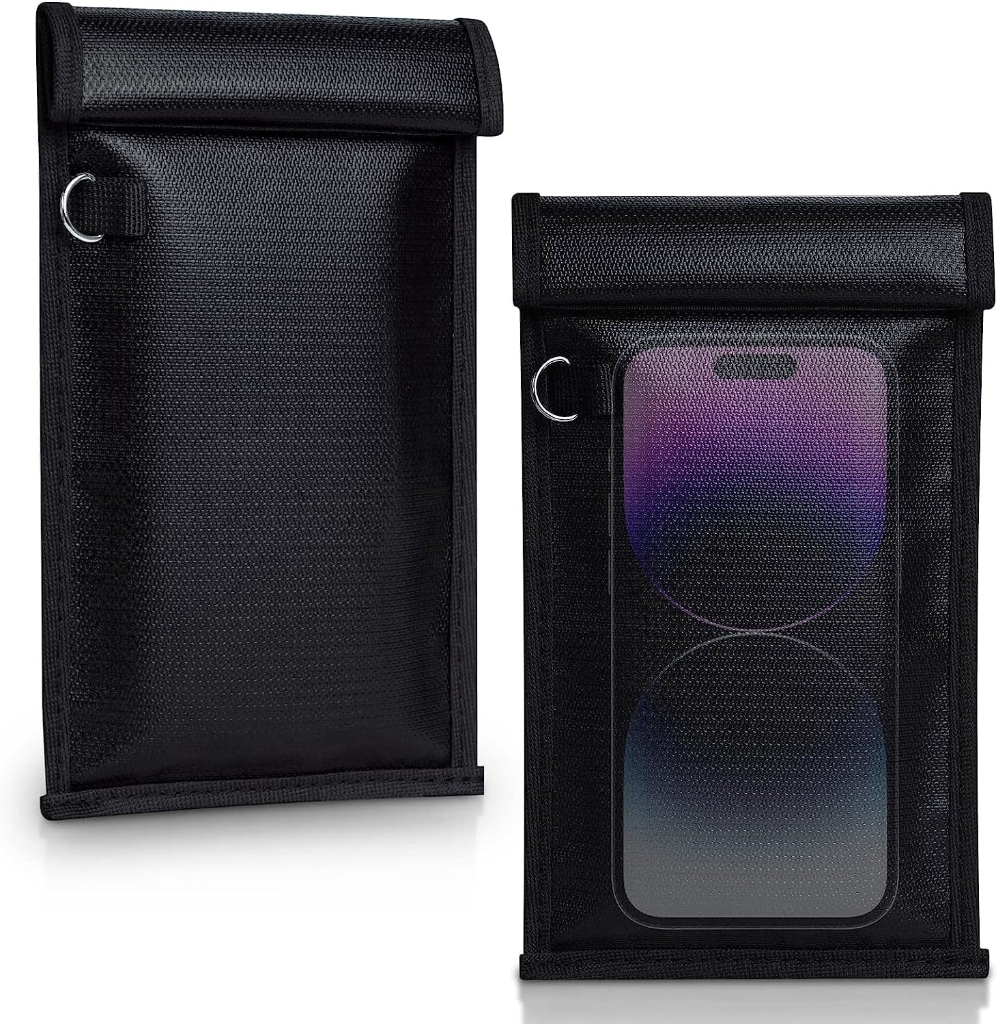
Simket 2-Pack Military Grade Faraday Bags
This listing states shielding effectiveness of “over 80 dB” — a real number attached to a real unit of measurement. It’s still a manufacturer claim, not an independently verified test result, so it shouldn’t be taken as confirmed fact. But it’s a meaningfully stronger claim than one with no figure at all, because it’s at least falsifiable — someone could actually test it and check.
View on Amazon →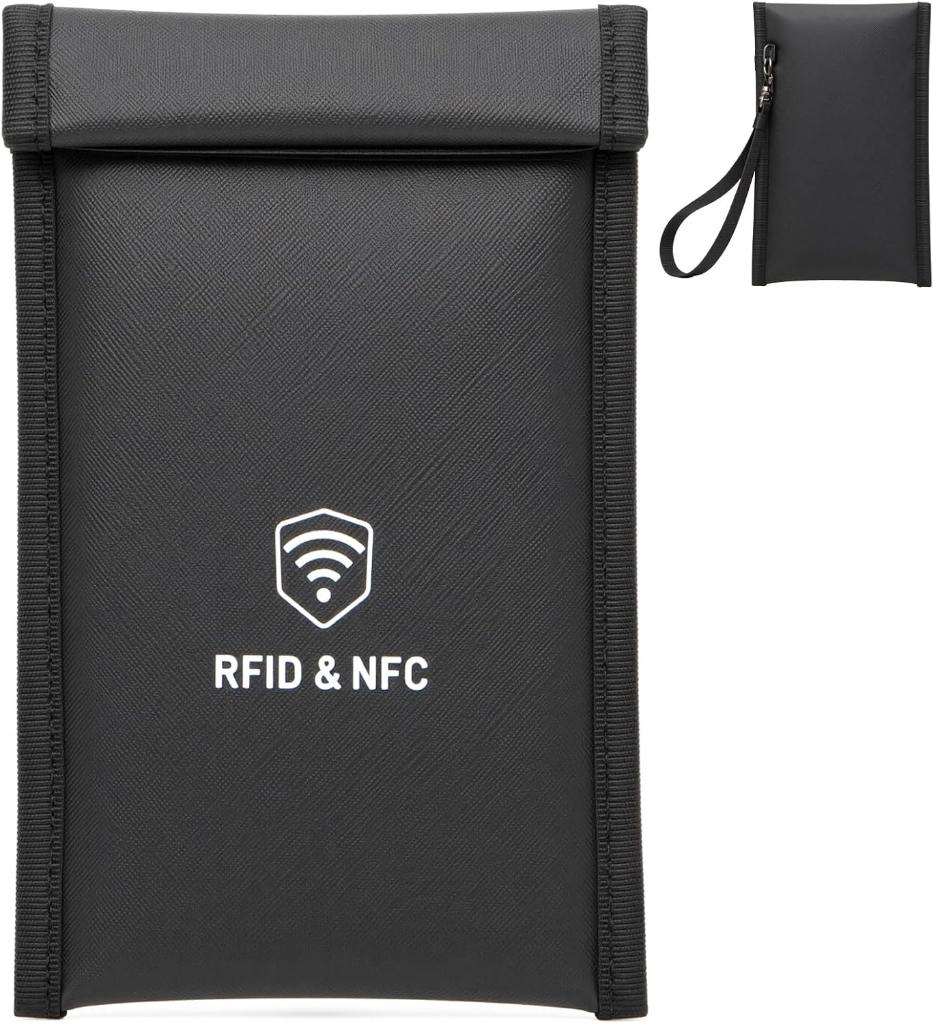
XIAODUN Faraday Bag for Phones
This listing describes “military-grade full-band signal shielding” and “absolute signal isolation” — no dB figure, no frequency range, no test method. This is exactly the pattern the Claim Check above is about: language designed to sound authoritative without giving you anything to actually verify.
View on Amazon →PrivacyLabz may earn a commission from qualifying purchases. Neither product has been physically tested by PrivacyLabz — this comparison is based solely on what each listing publishes.
Why bags lose effectiveness with repeated use
Unlike a rigid metal shielding enclosure, a flexible fabric bag gets folded, opened, and closed repeatedly, and that mechanical stress can measurably affect its shielding performance over time. This isn’t a hypothetical: a peer-reviewed textile engineering study testing conductive shielding fabric found its shielding effectiveness dropped by 6.89 dB at 2.4 GHz after 10 cleaning cycles, with the underlying mechanism being physical stress on the conductive threads and coating. Other research on flexible conductive textiles finds the general pattern consistent — resistance in the conductive layer tends to increase with repeated mechanical and cleaning stress, which reduces shielding effectiveness, though the extent varies by fabric type and construction.
The practical takeaway isn’t that Faraday bags wear out immediately — it’s that a bag’s shielding performance isn’t a fixed, permanent property from the day you buy it. Older, more worn bags are reasonable to be more skeptical of than the same design fresh out of the packaging.
So, does that mean Faraday bags don’t work?
No — it means “Faraday bags” as a category rests on genuine physics, while “this specific bag works exactly as advertised” is a claim about one product, not the whole category. A well-constructed bag, sealed properly, made from continuous conductive material, will measurably attenuate the signals it’s designed for. A poorly sealed one, or one that’s been folded and unfolded a few hundred times, may not perform anywhere near its original spec. The question worth asking isn’t “do Faraday bags work” — it’s “does this Faraday bag, in its current condition, work for the signal I actually care about.” For a full explanation of the underlying mechanism, see What is a Faraday bag?; for a home-testing approach that can catch obvious failures, see How to test a Faraday bag.
Frequently asked questions
Is there a dB figure that counts as "good enough"?
It depends what you’re blocking and why — there’s no single universal threshold that applies to every use case. What matters more than any single number is whether a product publishes a tested figure at all, at a stated frequency, rather than an unquantified claim like “military-grade.”
Does a more expensive Faraday bag mean better shielding?
Not necessarily and not automatically — price doesn’t directly correlate with tested performance. It’s a reasonable proxy for build quality in general, but the only way to know is a published, attributable test figure, not the price tag.
Can I improve a bag's performance myself?
Not reliably. Unlike a padded case, shielding fabric with damaged conductive fibers can’t really be repaired at home in a way that restores its original attenuation — replacing a worn bag is the more reliable option.
How would I know if my bag has degraded?
A basic home test (sealing a phone inside and calling it from another line) can reveal an obvious failure, but it won’t tell you about smaller performance drops across other frequencies. See How to test a Faraday bag for a fuller walkthrough and its limits.
Sources & Technical Literature
- “Designing an RF Shielded Enclosure” — Interference Technology. Aperture and seam discontinuity analysis, slot-antenna RF leakage models.
- “Shielding: The Hole Problem” — Electronic Design. Seam leakage mechanics and continuous conductive contact mitigation.
- “Durability of Shield Effective Polyester Cotton Fabric with Integrated Stainless Steel Threads in Processes of Dry and Wet Cleaning” — Polymers / PubMed (2023). Measured 6.89 dB shielding effectiveness loss at 2.4 GHz following cleaning stress.
- “Washability of E-Textile Materials” — Analysis of conductive resistance increases under repeated mechanical and laundering cycles.