That’s the short version. The longer version matters more: a Faraday bag isn’t magic, and not every product sold under that name performs the same way. How well it works depends on the shielding material, how the bag is sealed, and how it’s built — not just whether the label says “Faraday.”
What does a Faraday bag do?
Every wireless device you own is constantly sending or receiving radio-frequency (RF) signals, even when it looks idle. Phones stay in contact with cell towers, Wi-Fi networks, and Bluetooth devices. Cars with keyless entry constantly listen for a signal from your key fob. Laptops and tablets do the same over Wi-Fi and Bluetooth.
A Faraday bag is designed to interrupt that. Seal a device inside a well-made one, and the signals it would normally send or receive get attenuated — reduced enough that the connection effectively drops.
The signals a Faraday bag might attenuate typically include:
- Cellular (2G through 5G)
- Wi-Fi
- Bluetooth
- GPS/GNSS reception
- NFC and RFID
- Keyless-entry (key fob) signals
Not every Faraday bag attenuates every one of these, or to the same degree. A bag built and tested for phone signals isn’t automatically effective against a car key fob’s specific frequency, and a cheap pouch with a single fold-over closure may leak more than one with better closure engineering. Coverage is a property of the specific product, not a guarantee that comes bundled with the word “Faraday.”
How does a Faraday bag work?
The underlying idea dates back to 1836, when physicist Michael Faraday demonstrated that a continuous conductive enclosure could shield its interior from an external electric field. In simplified terms: when an electromagnetic field meets a conductive surface, charges in that material redistribute themselves in a way that opposes the incoming field, reducing how much of it reaches the inside. The real physics is more involved than that one sentence — it depends on frequency, material conductivity, and thickness — but that’s the practical effect.
That’s genuinely established physics, not a marketing claim. What’s harder is turning it into a flexible fabric pouch. A rigid metal box is a straightforward Faraday cage. A soft bag has seams, folds, and a zipper or velcro closure — fabric that flexes and wears with use. Every one of those is a potential gap. Higher-frequency signals have shorter wavelengths, which means even a very small gap can let some signal through, while lower-frequency signals are comparatively harder to leak through the same size opening.
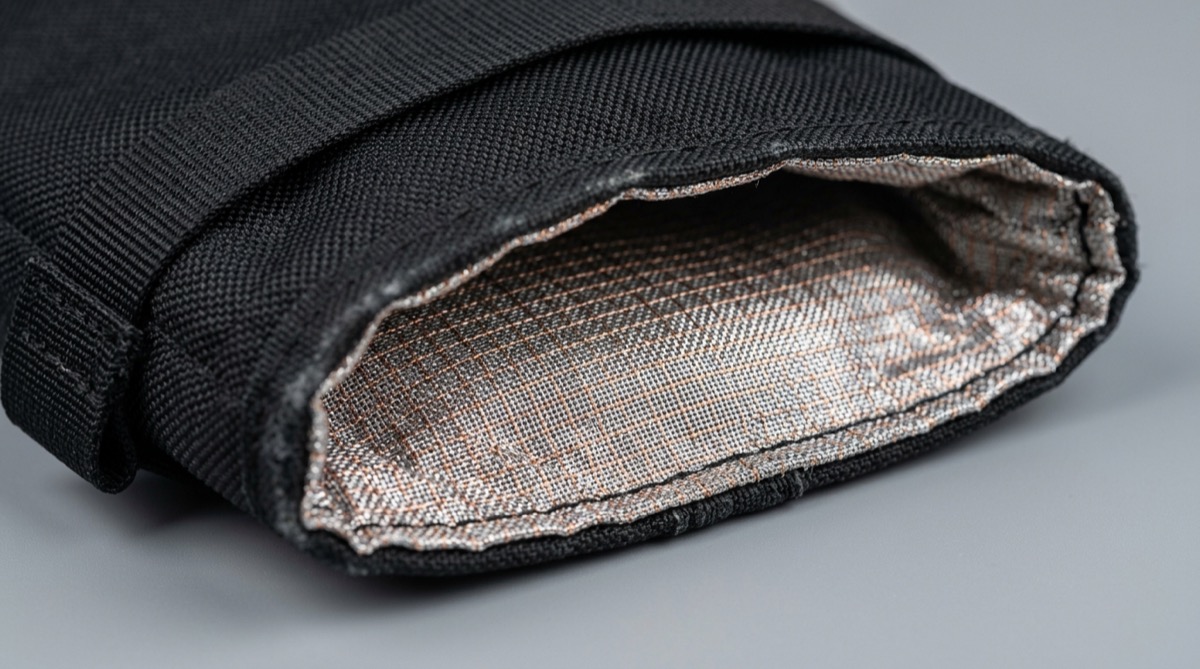
This is also why closure design matters as much as the fabric itself. A bag can use good shielding material and still underperform if the closure leaves a consistent gap.
What are Faraday bags used for?
Phones. People isolate a phone inside a Faraday bag to stop location tracking, prevent a phone being remotely accessed while it’s meant to be off-network, or just get a genuinely uninterrupted break from notifications without powering the device off. See Faraday bags for phones for what to look for in a bag sized and sealed appropriately for a phone.
Car key fobs. Modern keyless-entry key fobs constantly emit a low-power signal that lets a car detect when the key is nearby. This is exploited by “relay attacks” — one device near the key (often inside a house) captures and amplifies that signal, relaying it to a second device beside the car, tricking it into thinking the key is present. This is a recognised enough theft method that UK lawmakers and police agencies have moved to criminalise the possession and sale of electronic relay-attack devices. A Faraday bag or pouch is one way to stop a key fob’s signal being captured while it’s not in use — though it only helps if used consistently, and only if it’s sized to fully enclose the fob. See Faraday bags for key fobs.
Laptops and tablets. Larger devices need a larger bag, with the same shielding principles applying across more surface area and a bigger seam to seal properly. See Faraday bags for laptops.
Travel. Some travellers use Faraday bags as a general privacy measure while moving through airports, border crossings, or unfamiliar networks, reducing how much a device is actively broadcasting its location or connecting to networks it doesn’t need. This isn’t about assuming the worst everywhere — it’s a straightforward way to reduce unnecessary transmission. See Faraday bags for travel.
Three examples of Faraday bags you can buy
Faraday bags come in very different shapes and sizes. Rather than pretending there’s one “best” bag for everyone, these three examples show the kinds of products you’ll encounter, from different sellers and built for different devices.
PrivacyLabz may earn a commission from qualifying purchases. We have not physically tested these products unless explicitly stated.
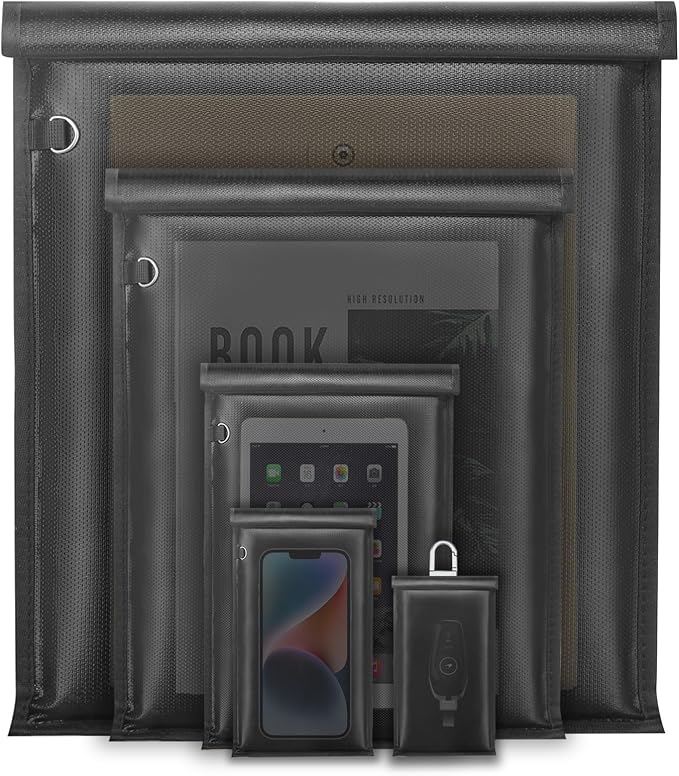
yaokvide 5-Pack Faraday Bags
Four pouch sizes in one set — from an oversized laptop cage down to a small key-fob bag. The listing claims signal blocking across Bluetooth, cellular, and car-fob frequencies, plus fireproof/waterproof fabric (manufacturer claims, not independently verified).
View on Amazon →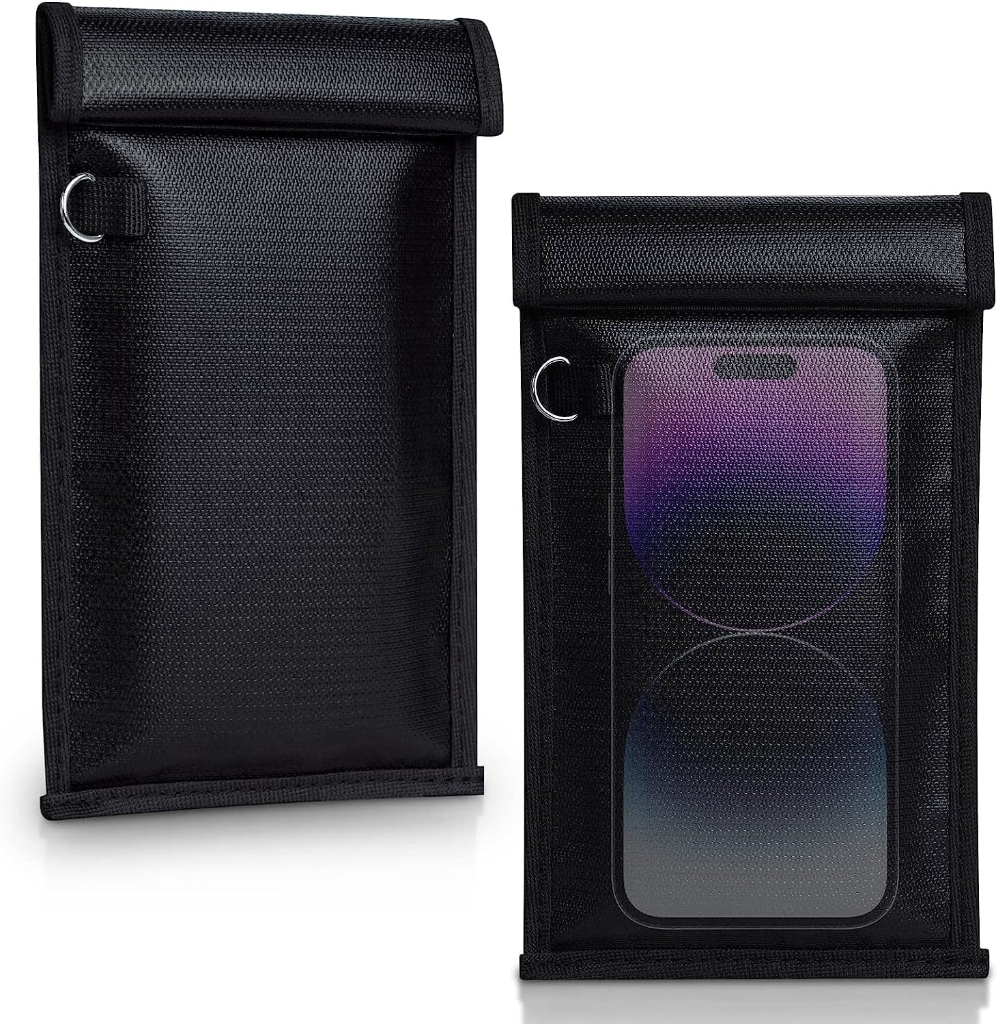
Simket 2-Pack Military Grade Faraday Bags
The only one of the three with a specific attenuation figure: the manufacturer claims “over 80 dB” shielding effectiveness — a real starting point, though still a manufacturer claim, not a third-party test.
View on Amazon →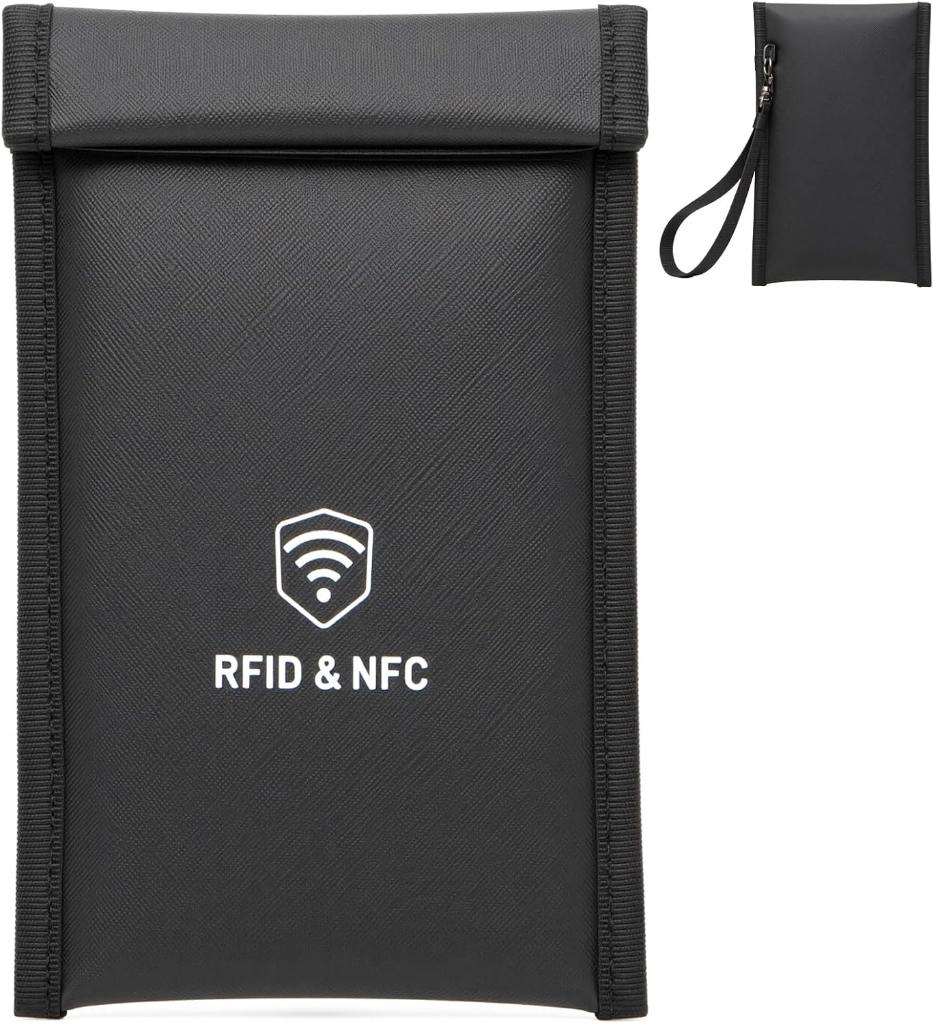
XIAODUN Faraday Bag for Phones
Smaller single-pouch design with a detachable wrist strap.
For full evaluation criteria and sizing considerations, explore our Faraday bags overview guide.
Do Faraday bags actually work?
Yes, in the sense that the underlying physics is real and well established — electromagnetic shielding isn’t a fringe idea; it’s used in contexts from EMP protection to forensic evidence handling. Whether a specific bag you buy performs as advertised is a different question, and it depends on the shielding material, construction quality, closure design, wear and damage over time, and the specific frequency you’re trying to block. We go deeper on this in Do Faraday bags actually work? — the short version: established science, product-specific performance.
Sounds impressive. On its own, it tells you almost nothing useful. What would actually help: which frequencies were tested, how much attenuation was measured in decibels, and what test method or standard was used. Without those three things, “military-grade” is a phrase, not evidence.
Faraday bag vs. Faraday cage: what’s the difference?
A Faraday cage is the general term for any conductive enclosure that provides this kind of shielding — a rigid metal box, a wire mesh room, or a soft fabric bag. A Faraday bag is specifically the flexible, portable version, built to be carried and used repeatedly rather than mounted or built into a fixed structure.
The trade-off is what you’d expect: a rigid, well-sealed metal enclosure is generally easier to make consistently effective than a soft bag that gets folded, zipped, and unzipped hundreds of times. That doesn’t make bags useless — it means construction and closure quality matter more for a bag than for a solid box. See Faraday bag vs. Faraday box for a fuller comparison.
How can you tell if a Faraday bag is working?
There are simple checks you can do at home — sealing a phone inside and calling it from another line to see if it rings, for example. These can reveal an obviously non-functional bag: if the call connects normally, something’s wrong. But passing a basic call test isn’t the same as a laboratory RF shielding measurement across every relevant frequency — a bag could pass a cellular test and still leak Wi-Fi or GPS, since those operate at different frequencies with different leak characteristics. For a full walkthrough of home testing methods and their limits, see How to test a Faraday bag.
What a Faraday bag can’t do
Worth being direct about this, because it’s an easy thing to assume incorrectly: a Faraday bag blocks or reduces radio communication. That’s it. It doesn’t:
- Remove malware already on a device
- Delete data already stored on a device
- Provide encryption
- Protect an online account from being compromised
- Do anything at all once the device is taken back out of the bag
Putting a compromised phone in a Faraday bag stops it communicating while it’s inside — it doesn’t fix whatever’s wrong with the phone. Signal isolation and device security are different things, and conflating them is one of the more common, and more consequential, misunderstandings about what these products actually do.
What should you look for in a Faraday bag?
A short framework, not a product roundup:
- Size — it needs to fully enclose the device you’re protecting, with room to seal properly
- Closure design — velcro, magnetic roll-top, and zip closures all perform differently; a poorly designed closure undermines even good shielding fabric
- Shielding material and specifications — and whether those specifications are backed by anything beyond the manufacturer’s own claim
- Evidence — has the product been tested by anyone other than the company selling it?
- Durability — shielding fabric that cracks or thins with repeated folding performs worse over time
- Price relative to actual need — a phone-only user doesn’t need multi-device capacity, and vice versa
Not sure which Faraday bag you need? Explore our Faraday bags overview guide →
Frequently asked questions
Does a Faraday bag block GPS?
A well-made one can significantly reduce GPS reception, since GPS signals fall within the range Faraday shielding generally attenuates. Whether a specific bag actually does this depends on its construction and closure — see What do Faraday bags block? for more.
Does a Faraday bag block Wi-Fi and Bluetooth?
Both typically fall within the frequency ranges Faraday bags are designed to attenuate, but as with GPS, actual performance is product-specific rather than guaranteed by the category.
Will my alarm still work inside a Faraday bag?
Yes — alarms and reminders run locally on the device and don’t need an external network connection to trigger, so they’ll typically still sound, though muffled by the bag’s fabric.
Can a phone be tracked inside a Faraday bag?
If the bag is genuinely blocking the phone’s signals, it can’t communicate its location — but that depends entirely on the bag actually working as intended. Covered in more depth in Can a phone be tracked inside a Faraday bag?.