How phones actually get tracked
“Tracking” isn’t one mechanism — it’s several different ones, and they don’t all work the same way:
- Cellular network location. Your carrier can estimate a phone’s location based on which cell towers it connects to, which requires the phone to be transmitting on the cellular network.
- GPS/GNSS. The phone receives timing signals from satellites and calculates its own position. This is one-way — the phone doesn’t transmit anything to the satellites. But for that location to be useful for “tracking” by someone else, the phone typically needs a second step: reporting that calculated location somewhere, usually over cellular data or Wi-Fi.
- Wi-Fi-based positioning. Phones can estimate location by scanning for nearby Wi-Fi networks and comparing them against known network location databases — this requires the Wi-Fi radio to be active.
- Bluetooth crowd-sourced networks, like Apple’s Find My. A lost or offline device broadcasts an encrypted Bluetooth signal; any nearby device on the same network detects it and relays the location to the owner over that other device’s internet connection — not the tracked device’s own.
Each of these depends on the phone actually transmitting or receiving a radio signal at some point in the process. That’s the exact thing a working Faraday bag is designed to stop.

Why signal blocking addresses all of these
A properly sealed, well-built Faraday bag attenuates the frequency ranges each of these methods depends on — cellular, Wi-Fi, GPS reception, and Bluetooth are all among the signal types covered in What do Faraday bags block? If the phone can’t receive a cellular signal, it can’t be tower-located. If it can’t receive GPS, it can’t calculate a fresh position. If it can’t transmit Bluetooth, it can’t be picked up by a nearby Find My–style network. The mechanism is the same regardless of which specific tracking method is in play: no signal in or out, no way to communicate a location.
The detail most people miss: some phones can still broadcast when “off”

This is worth calling out specifically, because it changes how you should think about what actually stops tracking. Apple’s own documentation confirms that newer iPhones can continue broadcasting a Find My Bluetooth signal for a period even after the phone has been powered off, using a small reserve of power set aside for this purpose. That means powering a phone down isn’t a complete guarantee against this specific kind of tracking, the way people often assume it is.
A Faraday bag handles this correctly in a way that powering the phone off, on its own, doesn’t: shielding blocks the radio signal at the physical layer, regardless of what power state the device’s software thinks it’s in. If the Bluetooth signal can’t physically leave the enclosure, it doesn’t matter whether the phone is on, off, or in this low-power broadcasting state — the bag doesn’t care about the device’s internal state, only whether RF energy is getting through the shielding.
This is close to a direct quote from a real product listing. It’s evocative, but it’s also exactly the kind of language that promises a result without describing a mechanism. Whether a phone actually “vanishes” depends entirely on whether the specific bag attenuates the specific signals in question, sealed correctly, every time. A phrase like this tells you nothing about dB, frequency range, or test method — it’s marketing, not a specification.
A real-world case for why this matters: digital forensics
Law enforcement and forensic teams use Faraday bags for a documented, practical reason that has nothing to do with hiding from tracking: preventing a seized phone from receiving a remote wipe command or losing volatile data before it reaches a lab for analysis. If a suspect or an accomplice triggers a remote wipe over cellular or Wi-Fi after a device is seized, evidence can be destroyed before investigators ever see it — several documented cases describe exactly this happening when a phone wasn’t properly isolated in time. Multiple sources describe agencies (in the US, reportedly including guidance attributed to the Department of Justice — worth verifying against a primary DOJ source before publishing) recommending Faraday bags specifically for this reason.
This is a useful sanity check on the underlying physics: the same blocking mechanism that stops “tracking” is what evidence-handling procedures rely on to stop remote tampering. It’s a well-documented, serious use case, not just a consumer privacy feature.
One real limitation worth noting here: a Faraday bag can’t stop something that doesn’t rely on an external signal in the first place. Some apps are built with local, timer-based auto-delete — data that disappears after a set period regardless of whether the device is online. Since that’s triggered internally rather than by an incoming signal, shielding the device doesn’t affect it either way.
When a phone inside a Faraday bag actually could still be tracked
Being realistic about the failure modes matters as much as explaining the mechanism:
- The bag isn’t sealed properly. A gap in the closure can leak enough signal for a connection to be made, even briefly.
- It’s not actually an effective bag. As covered in Do Faraday bags actually work?, construction and closure quality vary a lot between products, and a bag that’s been worn or flexed heavily may perform worse than it did new.
- The location was already reported before the phone went in the bag. If a device’s last known location was already uploaded before it was sealed, that historical data point exists regardless of what happens afterward — the bag stops new location reports, not ones that already happened.
- The wrong frequency. A bag that handles Bluetooth and cellular well but hasn’t been tested at every frequency a device uses could still leak on whichever one it wasn’t built for — see What do Faraday bags block? for the specific gaps that tend to matter.
Three examples worth looking at
Three current listings, chosen because they illustrate the difference between a verifiable claim and a vague one, and one worth being skeptical of for a different reason.
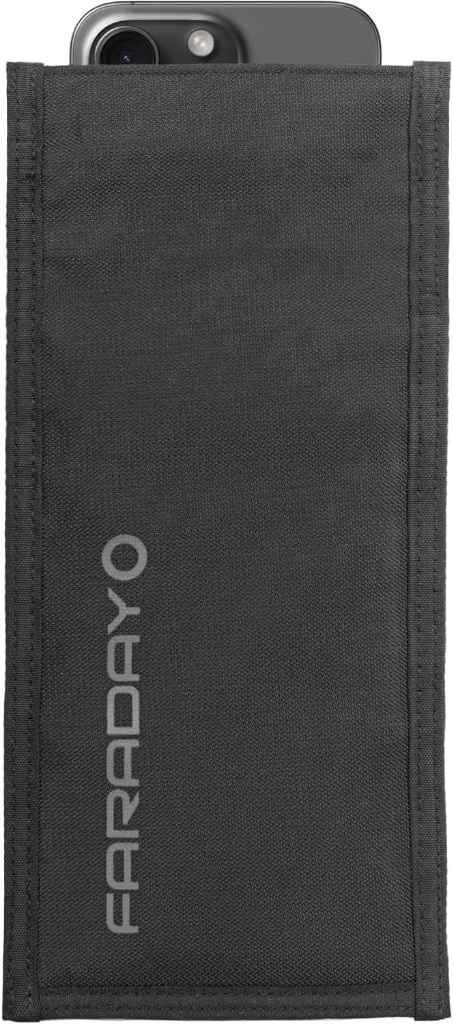
Faraday Defense — Faraday Bag Jacket Pro
This is the strongest specification we’ve come across in this product category so far: the listing states “-85dB attenuation, 400MHz–4GHz” — a real number and a frequency range, which is meaningfully more verifiable than most listings offer. It’s still a manufacturer claim, not an independent test result, but it’s the kind of claim that can actually be checked. Worth noting: this product is explicitly marketed toward law enforcement and evidence preservation use, which lines up with the forensic use case discussed above.
View on Amazon →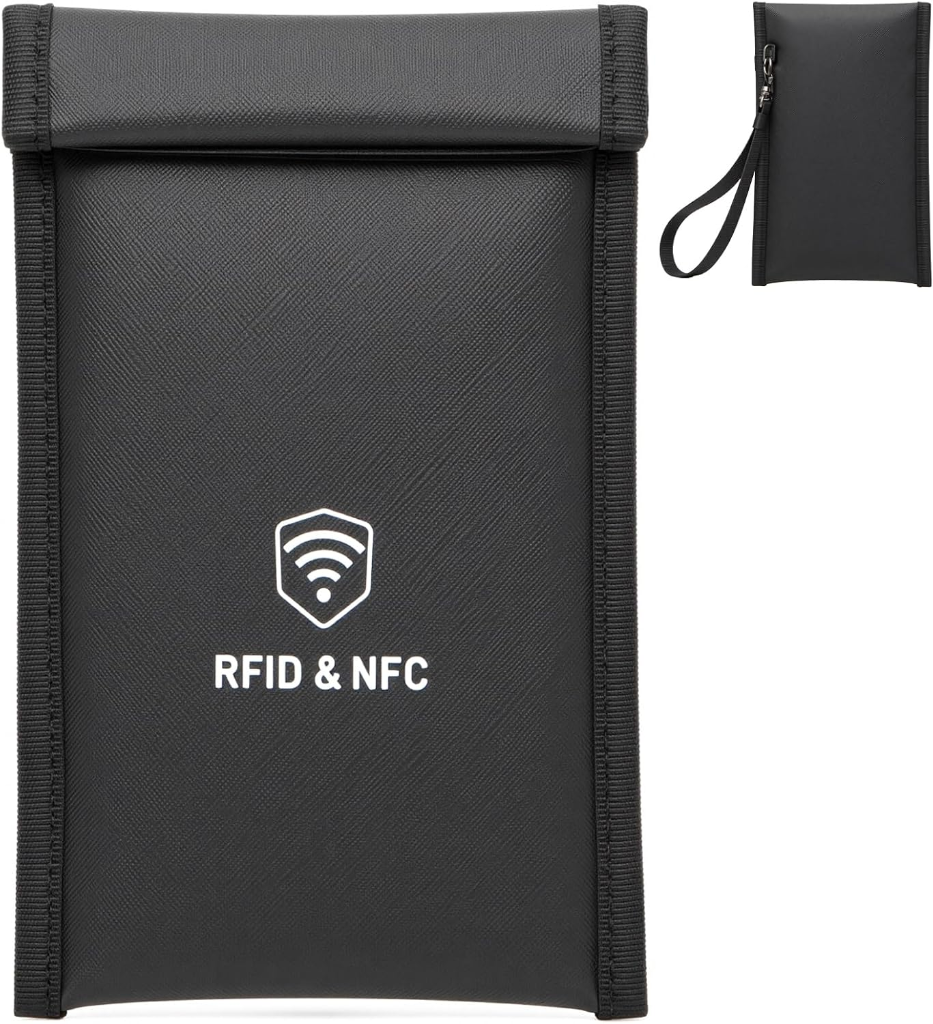
XIAODUN 2-Pack Faraday Bags for Phones
This is the same product line referenced in the Claim Check above — the listing describes “military-grade full-band signal shielding,” “absolute signal isolation,” and tells buyers to “vanish from the grid instantly.” No dB figure, no frequency range, no test method. Included here specifically as the real-world example that callout is about.
View on Amazon →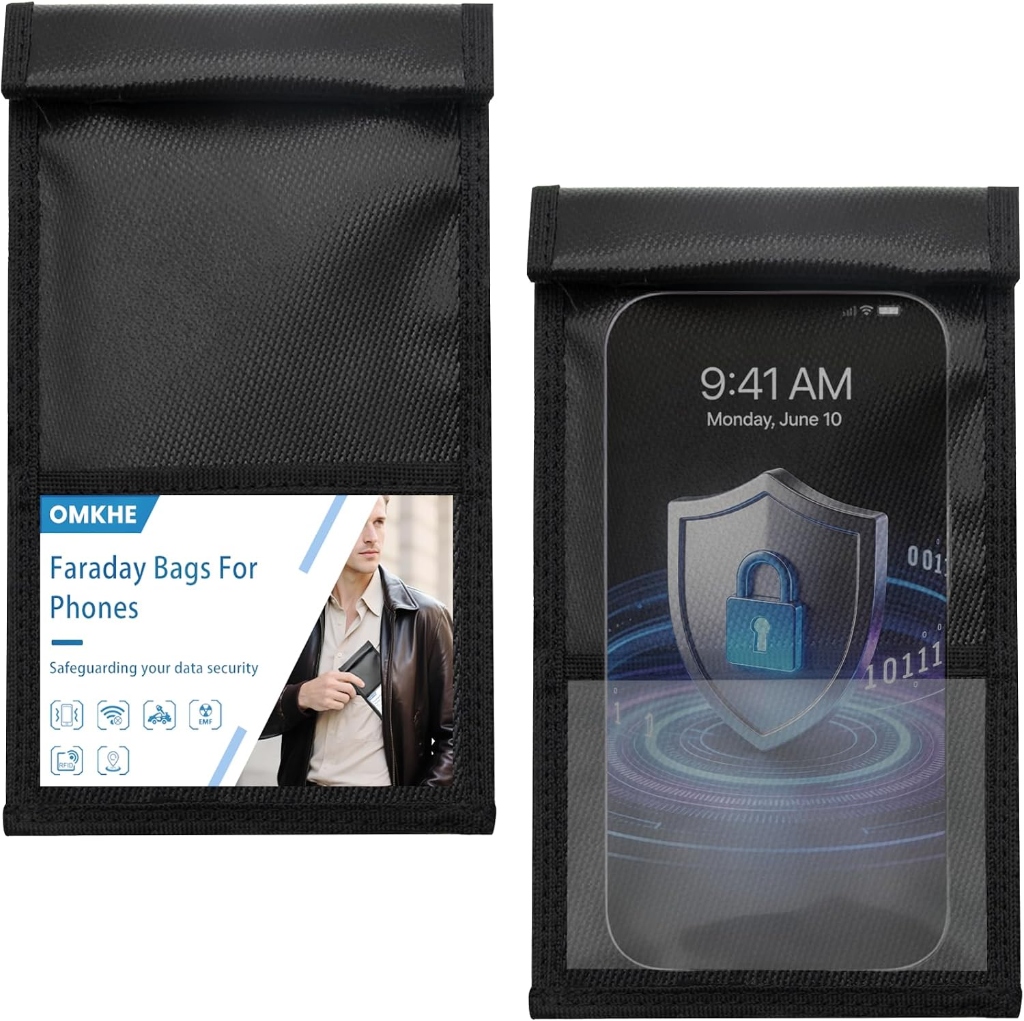
OMKHE 2-Pack Military Grade Faraday Bags
Reasonably specific on device coverage and closure design, but one part of this listing is worth flagging directly rather than repeating uncritically: it markets the bag as useful for “shielding pregnant women from radiation.” This isn’t a claim PrivacyLabz will validate or repeat as a real use case — it reads as the kind of fear-based marketing this site exists to be skeptical of, not an established medical recommendation. The signal-blocking function itself is the same category of claim as the other two listings; the radiation-shielding-for-pregnancy framing specifically is not something we’re endorsing by listing this product.
View on Amazon →PrivacyLabz may earn a commission from qualifying purchases. None of these products have been physically tested by PrivacyLabz — this is based solely on what each listing publishes.
Frequently asked questions
Does turning off Find My before bagging a phone make a difference?
It can reduce exposure to some tracking methods, but as covered above, some devices retain limited Bluetooth broadcasting capability even when powered off. Physical shielding addresses the signal directly rather than relying on a setting.
Is airplane mode enough on its own, without a Faraday bag?
Airplane mode is a software setting, and settings can be bypassed, misconfigured, or simply not disable everything a device is capable of transmitting. A properly working Faraday bag blocks the signal physically rather than relying on the device’s own software to behave correctly.
Can a phone's last known location still show up even if it's currently in a Faraday bag?
Yes — that’s a historical data point from before the bag was sealed, not a live one. The bag prevents new location data, not old data that already existed.
Does this apply to other tracking devices, like AirTags, the same way?
The same underlying mechanism applies — an AirTag also relies on Bluetooth broadcast to be found via a crowd-sourced network, so blocking that signal has the same effect.
Sources & Technical Literature
- “Find My & Privacy” — Apple Legal & Security Documentation. Crowd-sourced Bluetooth network mechanics and powered-off beacon broadcasting architecture.
- “Who Can Find My Devices? Security and Privacy of Apple’s Crowd-Sourced Bluetooth Location Tracking System” — Heinrich et al., arXiv (2021). Technical analysis of offline-finding beacon telemetry.
- “A game-changer in Faraday equipment” — Police1. Evidence preservation protocols and remote-wipe vulnerability case studies in seized devices.
- “Can a Faraday Bag Truly Protect Your Digital Evidence?” — Jemic Shielding Technology. Boundaries of physical RF isolation against local timer-based data expiration.