The basic distinction
A Faraday box (sometimes called a Faraday case or a small Faraday cage) is a rigid, fully enclosed container — typically metal or metal-lined, built for stationary use on a desk, in a lab, or in fixed storage. A Faraday bag is the flexible, portable version — conductive fabric sewn into a pouch with a fold, zip, or magnetic closure, meant to be carried and used repeatedly.
Historically, “Faraday cage” referred to something much larger — a wire-mesh enclosure or even a shielded room, used in labs and for industrial EMC testing. In consumer and prosumer contexts today, “box” and “cage” are often used interchangeably to mean the same thing: a compact, rigid, precision-built enclosure, smaller than a full room-scale cage but built the same way — solid conductive material with no flexing parts.
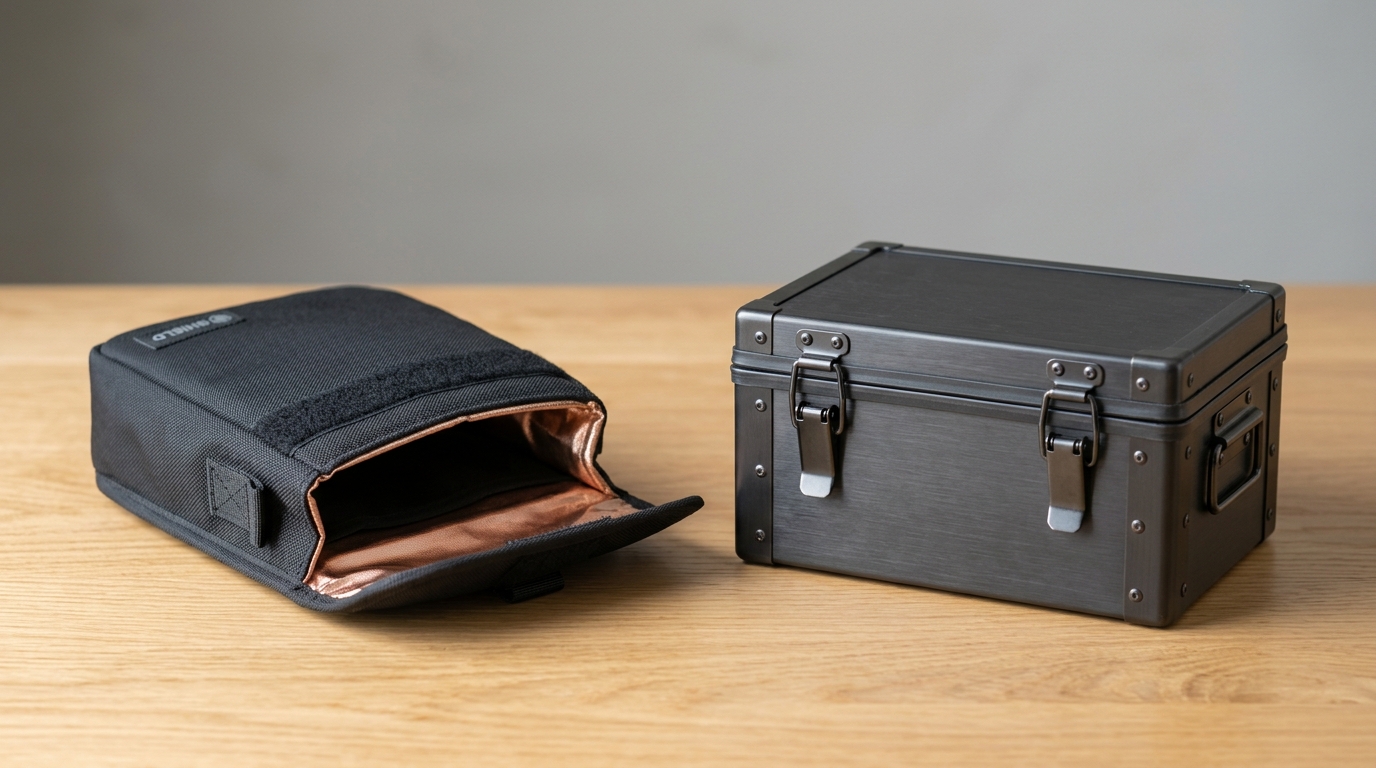
| Attribute | Faraday Bag | Faraday Box |
|---|---|---|
| Form | Flexible fabric pouch | Rigid metal/metal-lined enclosure |
| Portability | Pocketable, travels easily | Stationary — desk or fixed location |
| Typical use | Daily carry, travel, individual devices | Lab, evidence storage, fixed installation |
| Seal | Fold, zip, or magnetic closure | Solid lid or door |
| Wear over time | Can degrade with repeated folding/flexing | No flex-related wear — shielding doesn't fold |
| Typical capacity | One or a few small devices | Often multiple devices, larger items |
Why rigidity matters more than it sounds like it should
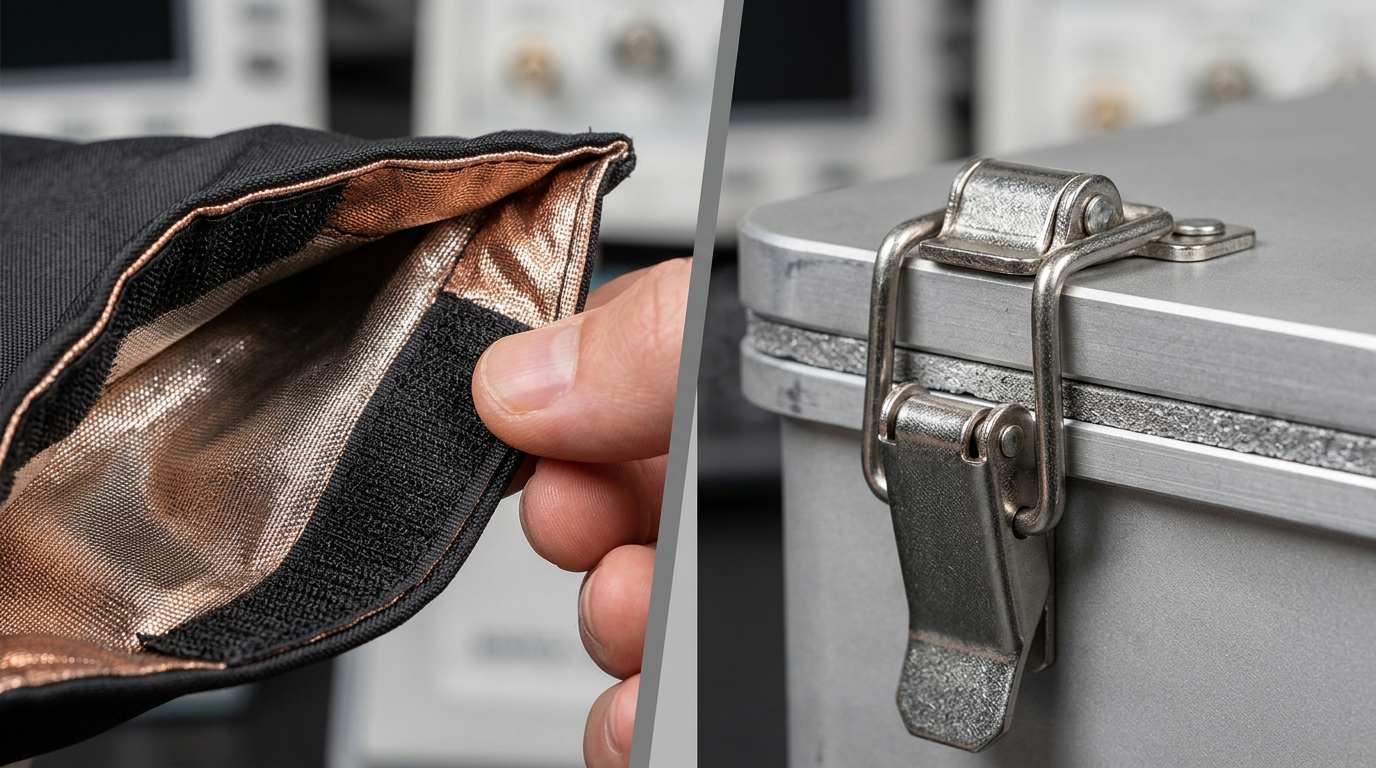
The single biggest practical advantage a box has over a bag isn't necessarily a higher out-of-the-box shielding number — it's that a box doesn't degrade the same way. As covered in Do Faraday bags actually work?, a flexible bag's shielding fabric is subject to real mechanical stress every time it's folded, opened, and closed, and a peer-reviewed study found measurable shielding loss after repeated stress cycles. A rigid box simply doesn't have that failure mode — there's no seam that flexes hundreds of times, so its shielding consistency tends to hold up better over the long run, independent of whatever its initial spec was.
This is also why closure design matters differently for each format. A bag's closure has to be refastened correctly every single time it's used, by whoever's using it, often in a hurry — a rushed or imperfect fold is a real, repeated opportunity for a gap. A box's lid or door is a fixed mechanical fit, engineered once rather than re-created by hand with every use. That's not a reason to assume every box outperforms every bag — construction quality still varies within both categories — but it's a structural reason rigid enclosures tend to be more forgiving of user error over time.
This claim shows up on at least one site that sells Faraday bags specifically. That doesn't automatically make it false, but it's worth noticing when a comparative performance claim comes from a source with a direct commercial interest in one side of the comparison. A quality bag and a quality box can both reach strong attenuation figures — but "identical performance" glosses over the real, physical difference in how that performance holds up with repeated use, which isn't a marketing detail, it's a mechanical one.
One of each, side by side
PrivacyLabz may earn a commission from qualifying purchases. Neither product has been physically tested by PrivacyLabz — this is based solely on what each listing publishes.
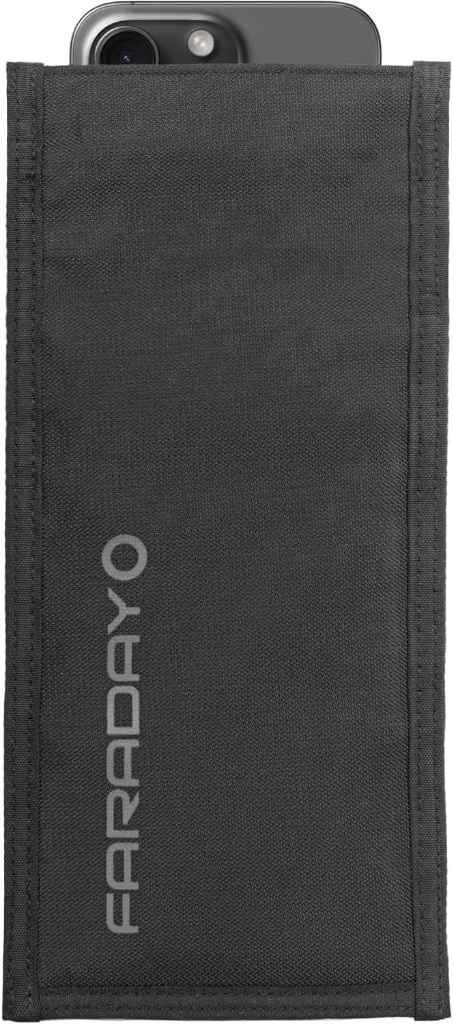
Faraday Defense — Faraday Bag Jacket Pro
Already covered in Can a phone be tracked inside a Faraday bag? — included here again because it’s the strongest specification claim found across everything reviewed for this site: “-85dB attenuation, 400MHz–4GHz.” Still a manufacturer claim, not an independent test result, but a genuinely verifiable one.
View on Amazon →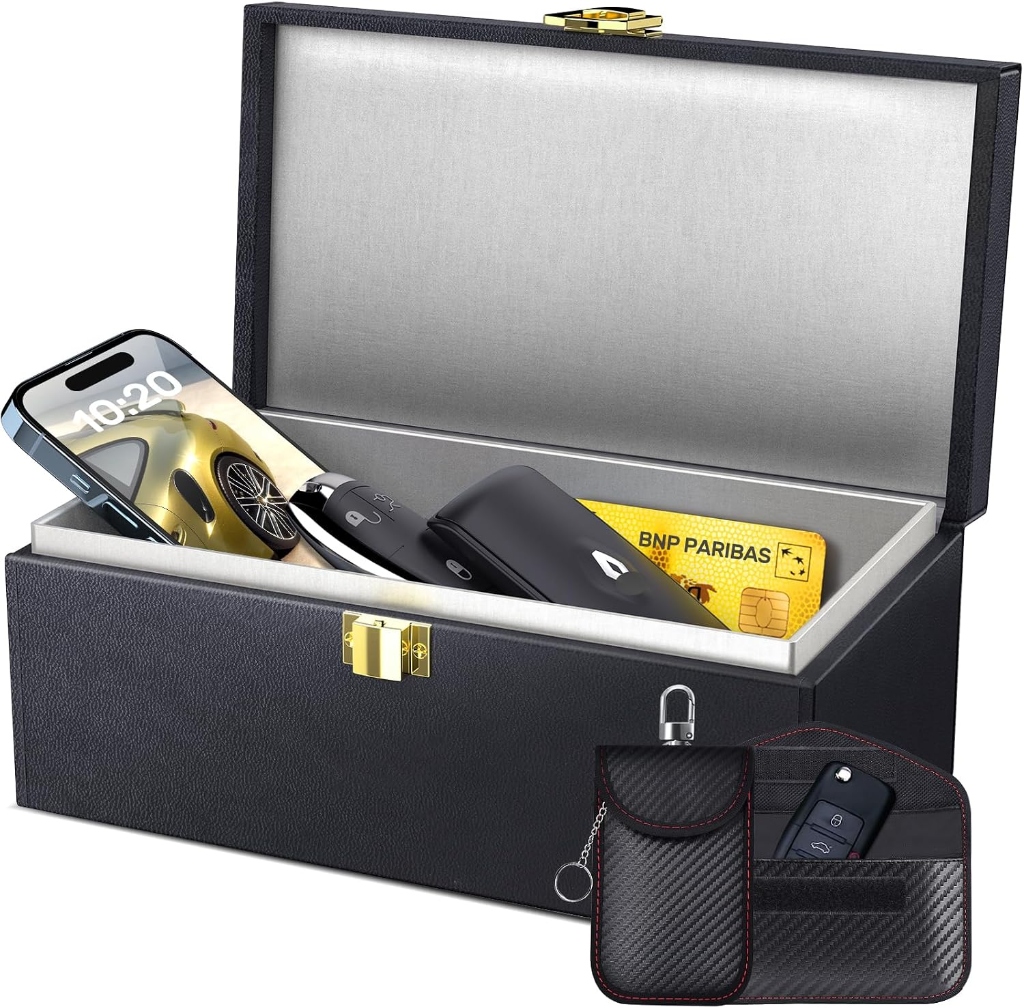
Samfolk Faraday Box with Faraday Bags
A wood-and-PU-leather box (8.6″ × 5.1″ × 4.1″) holding 6–8 keys. Despite costing more and carrying over 16,000 ratings, the listing only claims to “effectively block all signals” with no dB figure or frequency range — showing that a rigid box doesn’t guarantee a substantiated claim.
View on Amazon →When a bag is the right call
If the thing you're protecting needs to move with you — a phone during travel, a key fob on your keyring, a laptop you're carrying between locations — a bag is the only practical option. A box isn't something you fold into a bag or carry in a pocket. For most everyday, individual-device use cases covered elsewhere on this site (see Faraday bags for phones, key fobs, travel), a bag is the appropriate format, full stop — portability isn't a nice-to-have here, it's the entire point.
When a box is the right call
A box makes more sense when portability isn't a priority and consistency or capacity is: permanent desk or lab storage, protecting multiple devices at once, or any setting where the enclosure stays in one place and gets opened/closed far less often than a daily-carry bag would. This is also the more common choice in forensic and evidence-handling contexts specifically because of the durability point above — an enclosure that isn't being folded and refolded holds its shielding integrity more predictably over the length of a case, which matters when a device might sit in storage for months before evidence processing is complete.
Boxes also tend to make more sense for long-term contingency storage — protecting spare radios, backup drives, or other equipment against a possible EMP or solar event, where the enclosure might sit untouched for years. A bag being folded, unfolded, and generally handled is part of what makes it useful day-to-day; for something you're putting away and hoping never to need, that same handling isn't happening, so a box's main advantage (durability under repeated use) matters less, and its main disadvantage (poor portability) doesn't matter at all — which is part of why long-term storage use cases skew toward boxes even outside professional settings.
Can you use both together?
Yes, and it's a legitimate approach rather than overkill for certain use cases: some security and forensic setups place a bagged device inside a box for extra redundancy — the bag as a portable first layer, the box as a stationary, more durable second layer once the device reaches a fixed location. This isn't necessary for ordinary daily use, but it's worth knowing the two formats aren't mutually exclusive if your situation genuinely calls for both.
The honest answer
For almost everyone reading this for personal, daily-use reasons — protecting a phone or key fob — a bag is the right format, not because boxes don't work, but because the portability trade-off is the whole reason you're looking at this category in the first place. A box becomes the better choice specifically when the thing you're protecting doesn't need to leave a fixed location, when you're storing more than a bag can reasonably hold, or when you're setting something aside for long-term contingency storage rather than daily use. It's a use-case decision, not a “which one is secretly better” decision.
Frequently asked questions
Are Faraday boxes generally more expensive than bags?
Consumer Faraday bags are typically a lower cost of entry than a dedicated box, since a box requires rigid material and precision construction rather than sewn fabric. Exact pricing varies a lot by brand and claimed specification, and this article isn’t the place to cite specific figures given how much the market varies — check current listings for either format rather than relying on a fixed number here.
Do Faraday boxes need to be tested the same way as bags?
The same basic logic applies — a stated spec is a manufacturer claim until verified, regardless of format. The home-testing approaches in How to test a Faraday bag work for a sealed box in the same way they do for a bag, since the principle being tested (does a signal get through) doesn’t change with the enclosure’s rigidity.
Is a box automatically safer for sensitive evidence than a bag?
Not automatically — a poorly made box with a bad seal can underperform a well-made bag, and vice versa. What a box offers is more consistent performance over repeated use, not a guarantee of a higher starting spec.
Can I make my own Faraday box instead of buying one?
A metal container with a tight-fitting conductive lid (some people use ammo cans or similar) can function as a basic Faraday box if it seals well, though as with any DIY shielding approach, it’s only as good as its actual seal integrity — see Do Faraday bags actually work? for the same seam-and-closure logic applied to bags, which holds for boxes too.
Sources & Technical Literature
- “Faraday Cage vs Faraday Box: Key Differences Explained” — Ramsey Electronics. Technical distinctions between large-scale Faraday cages and compact, rigid Faraday boxes for RF engineering and stationary device shielding.
- “Do Faraday Bags Actually Work?” — PrivacyLabz Technical Analysis. Analysis of mechanical degradation, repeated flexing wear cycles, and seam leakage in portable flexible shielding fabrics.