What is the Ridge Wallet?
The Ridge Wallet is built around a simple structural idea: two rigid plates, held together by screws, with cards sandwiched between them rather than slotted into fabric or leather pockets. An elastic band or strap on the outside holds folded cash (or, in some variants, swaps for a money clip), which is a fundamentally different approach to carrying cash than a bifold's internal bill compartment.
This puts it in a different category from most of what's covered elsewhere on this RFID Blocking section — it's not a leather wallet with an RFID-lined pocket, and it's not a fabric sleeve. It's a rigid card holder, positioned by Ridge as an everyday-carry (EDC) minimalist product, where the RFID-blocking claim is tied to the metal construction itself rather than an added fabric liner.
Featured Evaluation
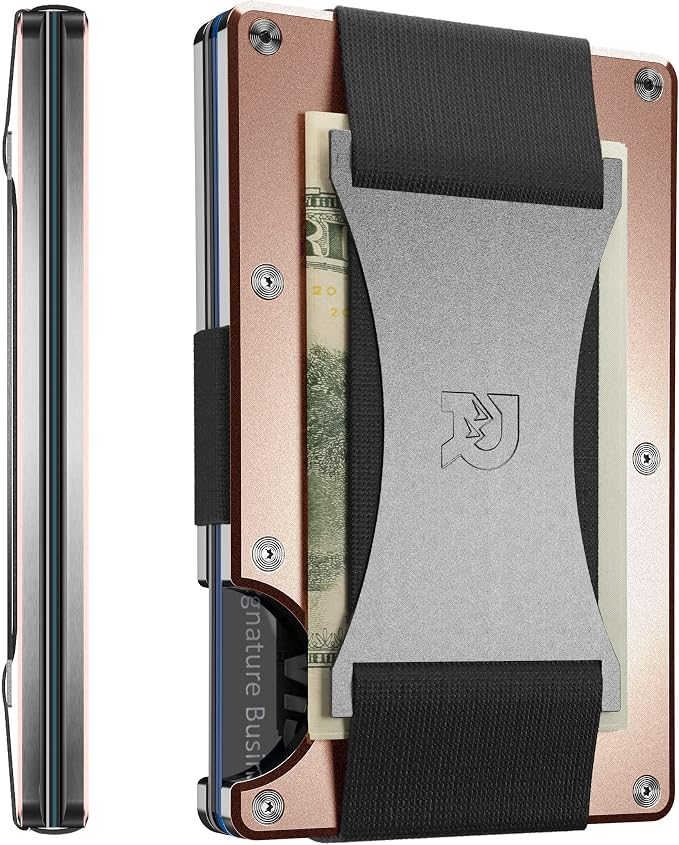
- Rigid aluminum construction genuinely differs from a fabric-lined wallet, not just marketing language
- Interchangeable screws allow some adjustment/repair rather than a sealed unit
- Compact footprint suited to front-pocket carry
- No published frequency or attenuation figure for the RFID-blocking claim
- “Military-Grade Durability” is stated without reference to a specific published standard
- This specific listing's own bullet copy describes the product as a “women's wallet” despite being titled for men — a copy-paste inconsistency worth knowing about, not a product defect
- Material: Aluminum (plates), elastic strap
- Card capacity: Up to 12 cards, per listing
- Closure: Elastic cash strap
- Included: Interchangeable screws, Torx T5 tool
How does the Ridge Wallet block RFID?
Ridge's own product description attributes the RFID-blocking function to the wallet's construction — the aluminum plates surrounding the cards. This is plausible in principle (a continuous conductive enclosure is the same general mechanism covered on the RFID Blocking pillar), but worth being precise about what it does and doesn't mean: RFID blocking addresses radio communication between a compatible contactless card and a reader. It does not protect against stolen card numbers from a data breach, phishing, compromised online accounts, or physical theft of the wallet itself. These are different problem categories entirely, and a rigid metal wallet doesn't touch any of them.
No published frequency or attenuation figure accompanies Ridge's RFID claim in this listing — it's described functionally (“shields your personal information”) rather than with a checkable number. That's not unique to Ridge; it's the norm across most of this product category, covered in more depth in Do RFID blocking cards work?
Frequency Reality Check
Contactless credit and debit cards (along with biometric passports) communicate using 13.56 MHz High-Frequency signals under the ISO/IEC 14443 standard. Ridge's aluminum plates provide solid conductive coverage across the faces of your cards. However, solid aluminum does not claim to attenuate wireless emissions from smartphones, cellular modems, or high-frequency transmitters, and shouldn't be confused with full-spectrum Faraday enclosures.
Ridge Wallet design and materials
The rigid-plate approach behaves differently from the alternatives covered elsewhere on this site. A leather bifold with an RFID-lined pocket relies on a fabric liner sewn into a flexible structure; an RFID sleeve relies on a thin fabric or foil enclosure around a single card; a rigid metal wallet relies on the structural material itself forming a more continuous enclosure around the whole stack of cards at once, by virtue of being solid rather than flexible.
This specific listing is the “Mountain Ridge” style in “Rose Quartz” — Ridge sells multiple color and pattern variants of what's structurally the same wallet, so the aluminum plate construction and 12-card capacity described here should be consistent across similar variants, though always worth checking the specific listing you're buying, given the copy inconsistencies already noted above.
How many cards does it actually hold?
Ridge's listing states a capacity of up to 12 cards. Worth separating the specification from the practical experience: 12 cards between two rigid plates is a genuinely different experience from 12 cards in a flexible leather slot — a rigid wallet at or near its stated capacity will be noticeably thicker and may be harder to pull individual cards from quickly compared to a bifold, where cards fan out more easily. If you only carry two or three cards day to day, the wallet will sit much thinner than its rated maximum; if you're regularly near the 12-card limit, expect it to behave more like a compact brick than a slim card case.
What about cash?
The cash strap system holds folded bills against the outside of the wallet with elastic tension, rather than storing them flat inside a compartment the way a bifold does. This is a genuine trade-off, not just a different aesthetic: a traditional bifold generally makes it easier to organize loose cash, receipts, and miscellaneous small items, while the cash strap approach keeps the wallet compact at the cost of that organizational flexibility. If you regularly carry receipts or small paper items alongside cash, this format is likely to feel more restrictive than a conventional wallet.
Ridge Wallet vs. a traditional RFID wallet
| Feature | Ridge-style metal wallet | Traditional RFID bifold |
|---|---|---|
| Size | Compact, rigid | Varies, generally flatter when empty but expands with contents |
| Card storage | Up to 12 cards between rigid plates | Typically multiple dedicated slots |
| Cash storage | External elastic strap | Internal bill compartment |
| RFID protection approach | Metal plate construction | Fabric lining in card slots |
| Organization | Minimal — cards stack together | Higher — dedicated slots and compartments |
| Pocket bulk | Low when lightly loaded, thicker near capacity | Generally consistent regardless of card count |
| Best for | Someone prioritizing a compact, minimal card carry | Someone wanting more organization and storage flexibility |
Neither format is universally better — they solve different priorities.
What we like
- Rigid structural shielding: The rigid aluminum construction is a genuinely different structural approach to RFID shielding than a fabric liner, not just repackaged marketing language.
- Modular serviceability: Interchangeable screws and an included tool suggest some repairability rather than a sealed, disposable unit.
- Front-pocket footprint: A compact footprint genuinely suits someone who wants the smallest practical wallet for a front pocket.
What to watch for
- Stack access friction: Minimalist, rigid-plate design isn't for everyone — it's a real adjustment from a traditional wallet's card access and organization.
- Cash handling trade-off: Cash handling via an elastic strap is a compromise, not strictly an upgrade, if you carry much cash or paper items.
- Unverified marketing language: “Military-Grade Durability” is stated without reference to any specific published testing standard — treat it as descriptive language, not a verified certification.
- Absence of lab data: No frequency or attenuation figure accompanies the RFID-blocking claim, consistent with most of this product category — RFID blocking here addresses one narrow technology, not payment-card fraud broadly.
- Premium price point: At $94.99 for this variant, it's priced well above simple RFID sleeves or fabric wallets that address the same core RFID question at a fraction of the cost — the extra spend buys the minimalist metal format specifically, not better-proven shielding.
Is the Ridge RFID wallet worth it?
Good fit if:
- You want a compact, rigid wallet rather than a traditional fold-out design
- You primarily carry cards, not much cash or paper
- You like minimalist EDC-style gear
- You want RFID blocking built into the wallet's core structure rather than added as a liner
Look elsewhere if:
- You regularly carry receipts, cash, or miscellaneous small items
- You prefer traditional bifold organization and quick card access
- You want the cheapest possible RFID solution — a sleeve or basic fabric wallet addresses the same RFID question for much less
- Rigid, minimalist wallet designs generally aren't your preference
Other RFID wallet options
If you're exploring different form factors, our RFID blocking wallets category compares traditional leather bifolds, carbon fiber cases, and high-capacity organizers. For high card capacity and checkbook storage, see our Big Skinny Slimvelope guide. To shield individual cards in an existing favorite wallet, see RFID blocking sleeves.
Frequently asked questions
Does the Ridge Wallet block RFID?
Ridge describes the wallet's aluminum construction as providing RFID-blocking protection. No published frequency or attenuation figure accompanies this claim in the listing reviewed.
How does the Ridge Wallet block RFID?
Per Ridge's own description, the aluminum plates surrounding the cards form the shielding — a different construction approach from a fabric-lined wallet, covered in more depth on our RFID Blocking guide.
How many cards does a Ridge Wallet hold?
Up to 12 cards, per the product listing — though a wallet near that capacity will be noticeably thicker than one lightly loaded.
Can you carry cash in a Ridge Wallet?
Yes, via an external elastic cash strap rather than an internal compartment — a different approach from a traditional bifold's bill storage.
Is a Ridge Wallet better than an RFID blocking wallet?
A Ridge Wallet is itself a type of RFID-blocking wallet — the comparison that matters is format: rigid metal card holder versus a traditional fabric-lined bifold, covered in the comparison table above. See our RFID blocking wallets page for the broader category.
Do you actually need an RFID blocking wallet?
Not automatically — it depends on whether proximity RFID reading of your specific cards is a real concern for you, separate from whether the underlying technology works. See RFID Blocking: The Complete Guide for the fuller reasoning, and Do RFID blocking cards work? for how this plays out across the category.
- Amazon Product Listing (link.amazon/B07TnVoVu): Product specifications, card capacity (up to 12 cards), cash strap description, material (aluminum plates, elastic), included components (interchangeable screws, Torx T5 tool), and listing copy. Treated throughout as manufacturer/seller claims, not independently verified facts.
- PrivacyLabz Prior Ridge Wallet Technical Research: Cross-referenced against this site's prior Ridge Wallet research (reviewed across the RFID Cards and Wallets pages) for consistency on the brand's general construction and claim patterns, not re-sourced from scratch.
- ISO/IEC 14443 & NIST Near-Field Standards: Cross-referenced against this site's own RFID Blocking pillar for inductive power coupling parameters and 13.56 MHz proximity frequency boundaries.