RFID Blocking Sleeves: How They Work & What to Look For
An RFID blocking sleeve is a thin enclosure designed to surround an RFID/NFC credential with conductive material that reduces communication between the credential and an external reader.
Typical uses include contactless payment cards, access cards, and some identification credentials — though not every RFID technology operates at the same frequency, and a sleeve built for one credential type isn’t automatically effective for another.
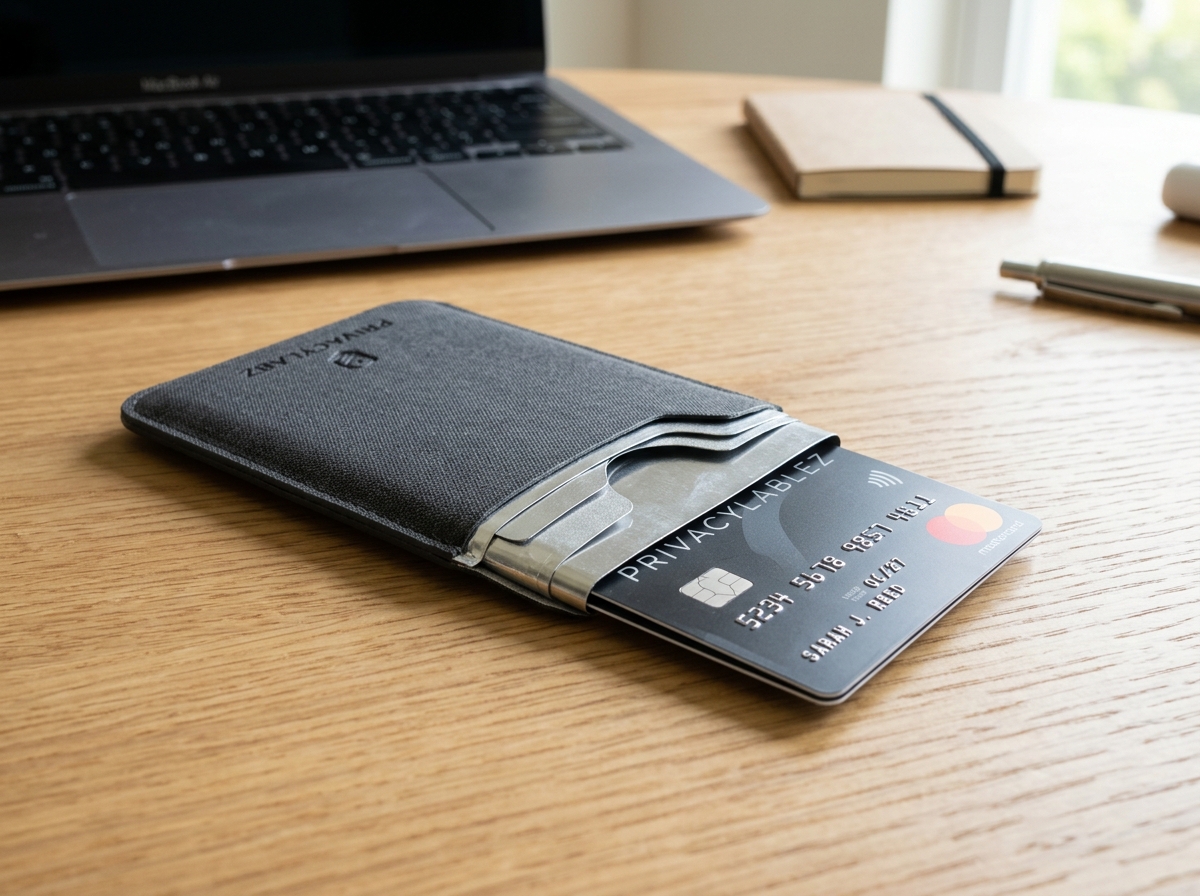
Unlike a blocking card placed somewhere inside a wallet, a sleeve physically surrounds the individual credential, which makes the protection concept simple. It also makes the inconvenience simple: the technology is fairly elegant; pulling your Visa out of a tiny sleeve every time you buy lunch is less elegant.
At a Glance // Sleeve Shielding Evaluation
What it isA conductive sleeve that surrounds an individual RFID/NFC credential.
Common useContactless payment cards, access cards, and other compatible credentials.
Main advantageProtection is attached to the individual card rather than the wallet as a whole.
Main drawbackThe credential normally needs to be removed from the sleeve for contactless use.
What mattersFrequency coverage, construction, fit, durability, and shielding continuity.
// CURATED EVALUATIONS
RFID blocking sleeves worth considering
A sleeve protects credentials individually rather than shielding an entire wallet. Below are five verified options spanning government-tested polymer laminates, color-coded multi-packs, and specialized Tyvek enclosures.
01
GOVERNMENT-TESTEDMOST TRANSPARENT
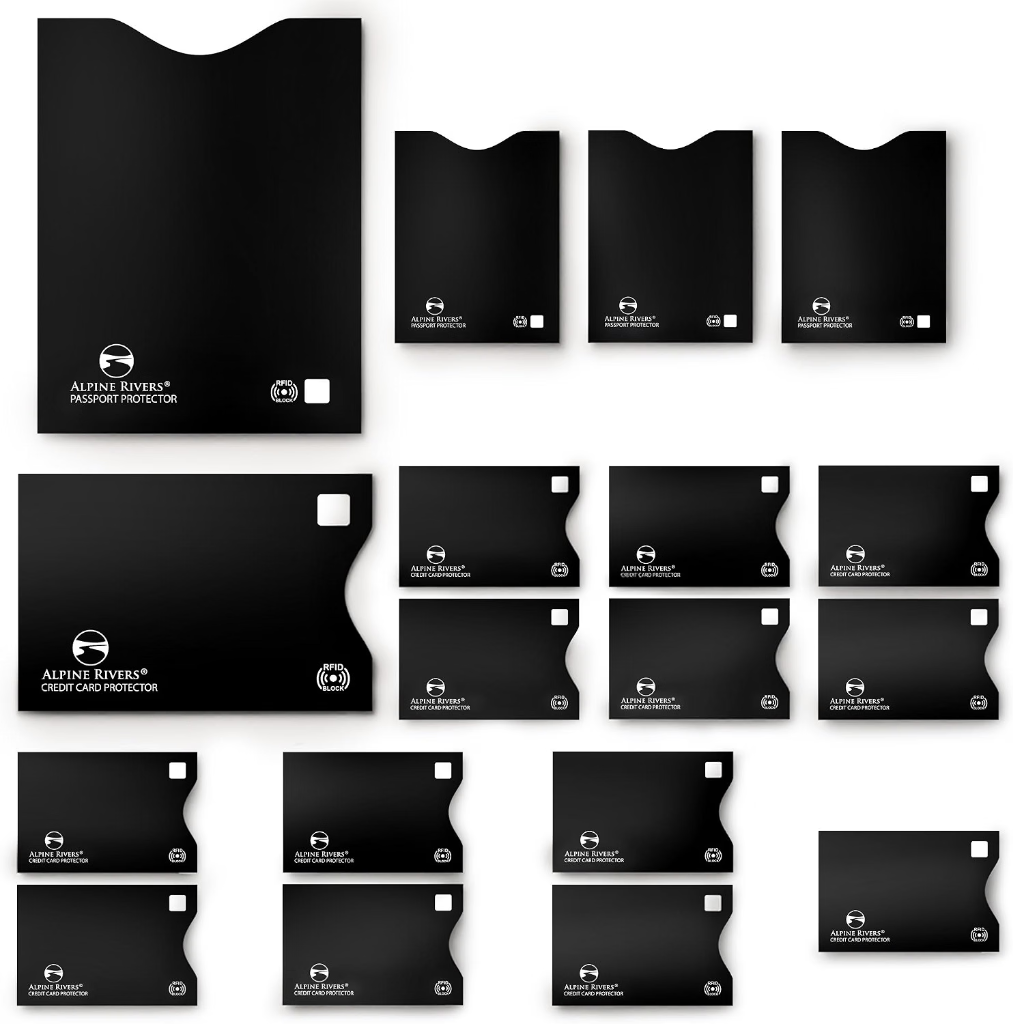
Alpine Rivers RFID Blocking Sleeves
An 18-piece set (14 card sleeves, 4 passport sleeves) made from a material Alpine Rivers calls PolyShield, stated to block 13.56 MHz — the correct frequency for contactless payment cards and e-passports under ISO/IEC 14443. The listing states the material passed the US government's FIPS 201 standard in 2016 and was added to the GSA Approved Products List under record #1424. Alpine Rivers' own site adds an important, honest caveat: the GSA APL category for this product class has since been retired, so this isn't presented as an active current certification — just a real, historical, independently-verified test result for the material.
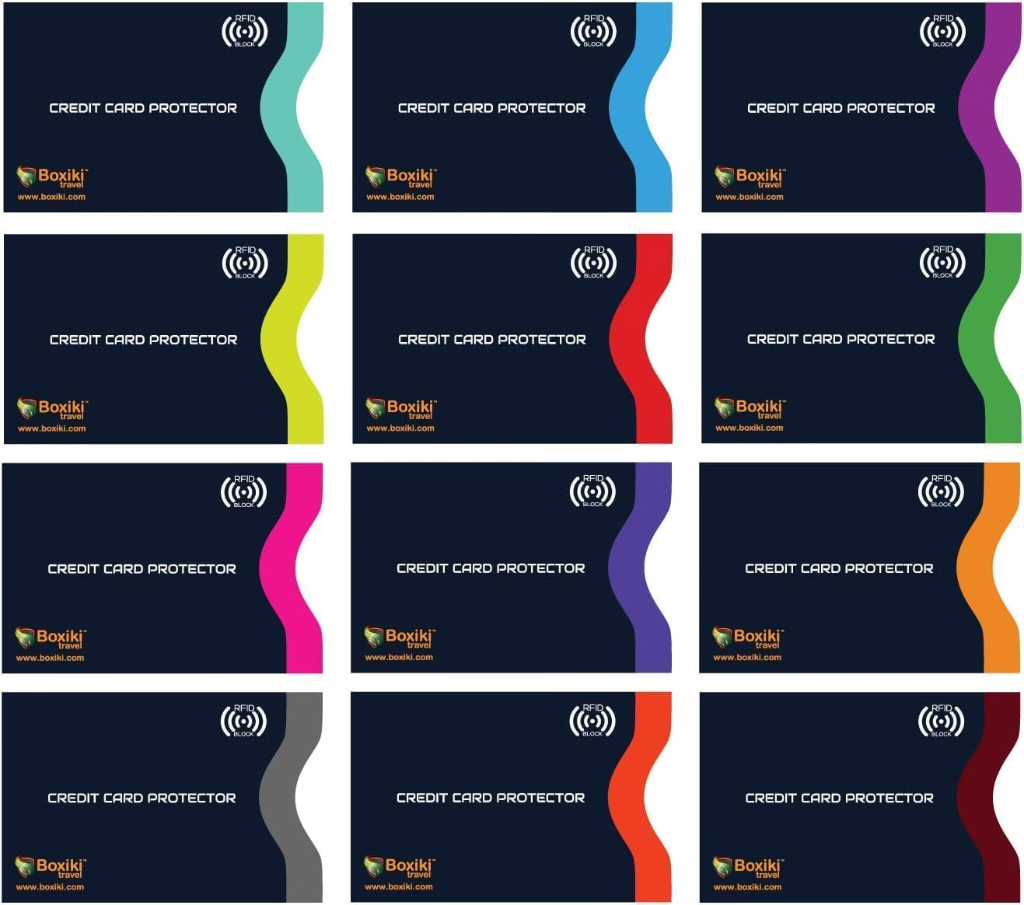
A 12-sleeve set made from art paper and aluminum foil, color-coded for quickly identifying which card is which. Worth flagging directly: the extended product description leans hard into fear-based marketing — "thieves using electronic skimmers are everywhere," warnings about accounts being emptied "within seconds" — without any cited statistic behind it. The core shielding claim itself is generic ("advanced RFID secure sleeve," "certified secure" with no certifying body named).
WHAT WE LIKE
Very high review count, 16,083 ratings
Color-coding is a genuinely useful feature
Lightweight, only 1.44oz for the set
WATCH FOR
Marketing leans on fear rather than evidence
“Certified secure” names no actual certifying body
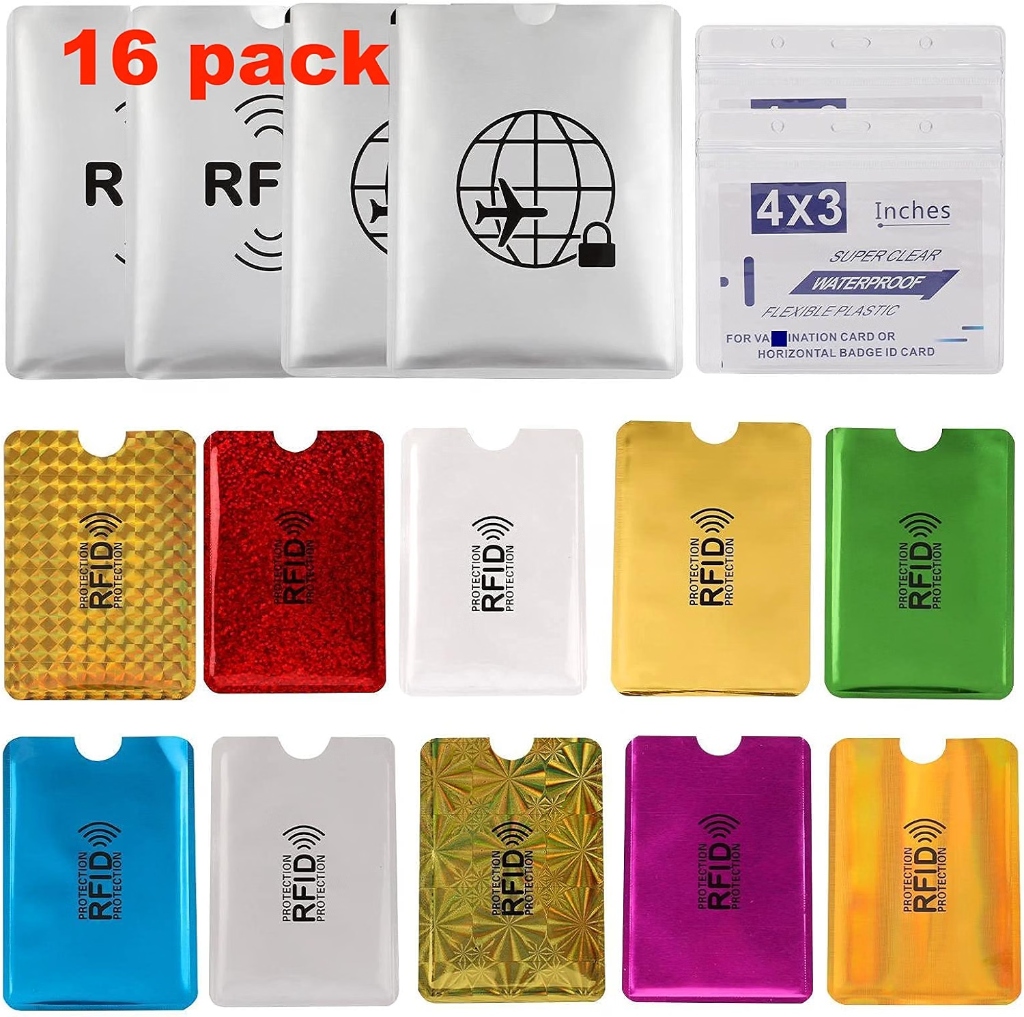
A 16-piece set (10 card sleeves, 4 passport sleeves, 2 bonus clear record-card protectors) in aluminum foil, 0.30mm thick, available in six colors. The cheapest of the five reviewed here. The listing's own copy reads as translated and somewhat generic — "intelligent design of high-tech materials" — with no frequency, no standard, and no specific mechanism named anywhere.
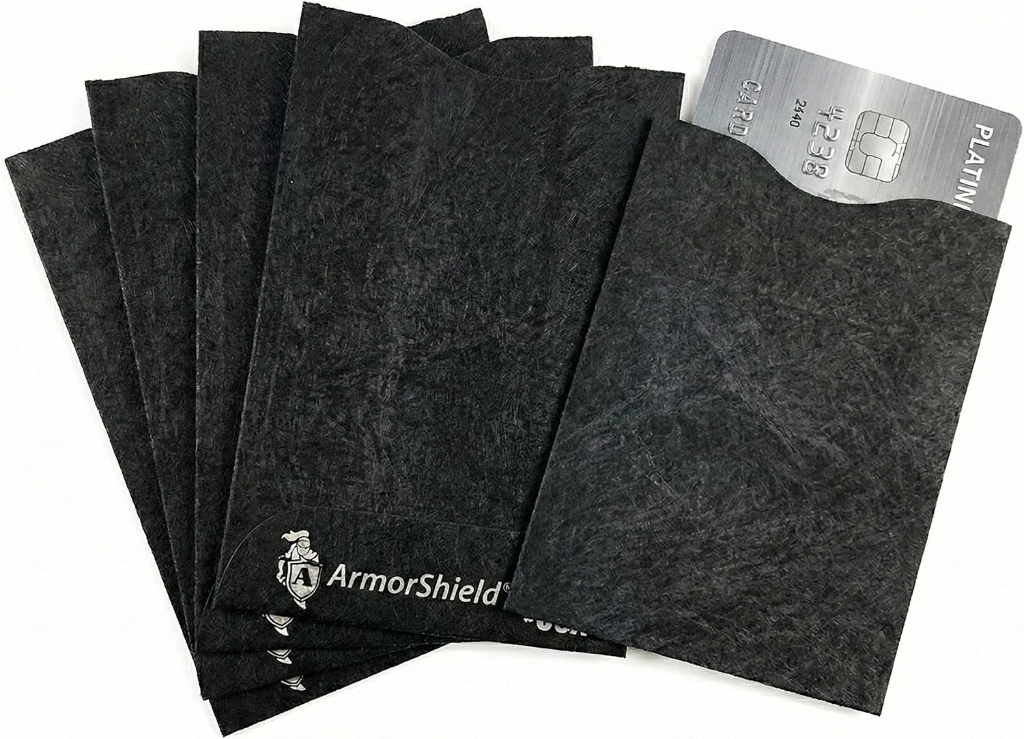
Made from genuine DuPont Tyvek with a proprietary "ArmorShield" interior coating, 100% made in USA. This is one of the few listings on this site to explicitly describe its own mechanism as passive: "our sleeves use passive Faraday cage technology — each sleeve creates an isolated shield around only the card physically inside it. Nothing outside the sleeve is affected" — an honest, specific, non-active claim, plus a useful specific reassurance that it won't interfere with a car key fob carried nearby. The listing also states "FIPS 201 Approved," the same certification category Alpine Rivers holds, though without Alpine Rivers' added transparency about the category's current status — worth checking against the same GSA record before treating it as equally verified.
WHAT WE LIKE
Genuine DuPont Tyvek, a real named material
States passive mechanism honestly and specifically
ID Stronghold RFID Blocking Credit Card Sleeve Protectors
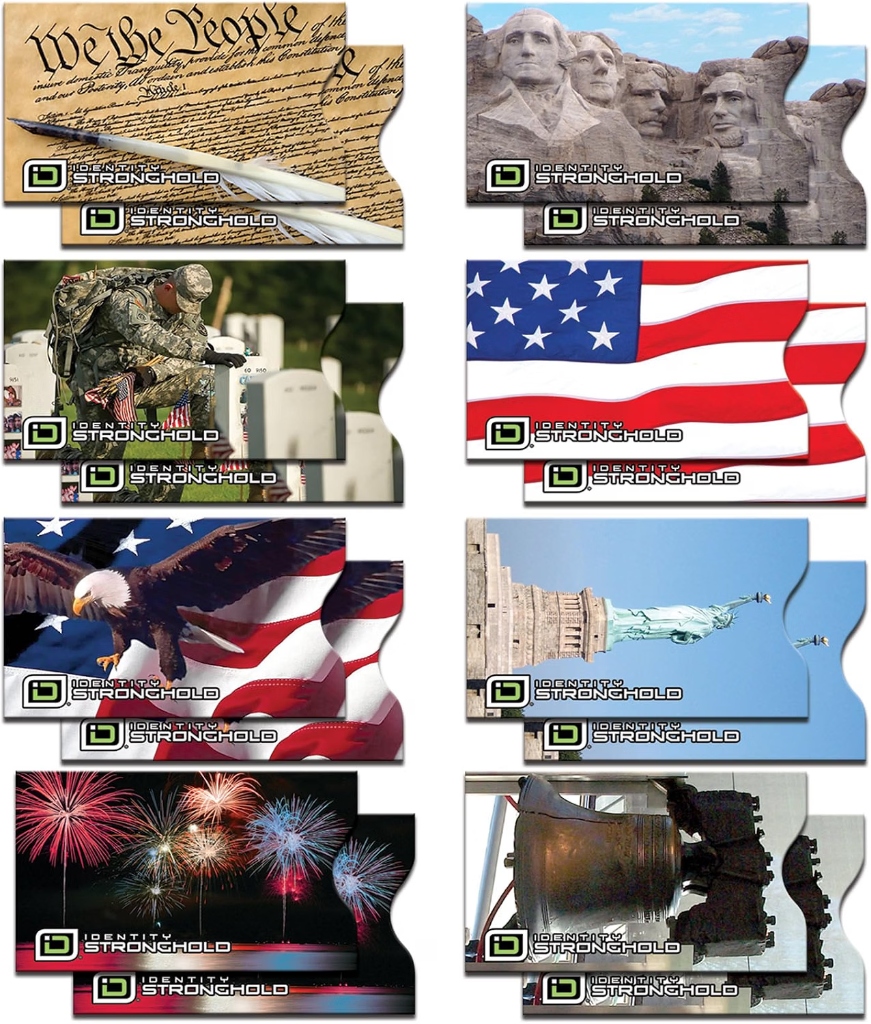
Made from Tyvek, in a patriotic flag-themed design, sold by ID Stronghold — a brand that, unlike most sellers reviewed across this site, appears to specialize specifically in RFID-blocking products for corporate, healthcare, and government use, not a general import catalog. Worth flagging directly: this specific listing has an internal inconsistency — the title says "16 Pack," a bullet says "16 individual sleeves," but the "what's in the box" section lists only 8 card sleeves plus 4 passport sleeves (12 total), and the separate product description paragraph says "8-pack." These numbers don't agree with each other within the same listing.
WHAT WE LIKE
Specialized brand focused on RFID security products
Affiliate Disclosure: PrivacyLabz may earn a commission from qualifying purchases. This does not affect the price you pay, nor does it influence our editorial evaluations. We have not laboratory-tested these products unless explicitly stated; specifications and certification records are verified via manufacturer listings and public GSA documentation.
Editorial Note // Government Testing & The FIPS 201 Disclosure Pattern
Federal Information Processing Standard 201 (FIPS 201) defines strict radio-frequency attenuation benchmarks for electromagnetically opaque sleeves protecting federal PIV credentials. While multiple consumer brands invoke FIPS 201 or GSA Approved Products List (APL) status, transparency varies sharply across retail listings. Alpine Rivers stands out as an exceptional example of honest disclosure: their brand documentation confirms PolyShield passed FIPS 201 in 2016 under GSA APL record #1424, while proactively clarifying that the GSA has since retired that specific product category — treating it as a legitimate historical material benchmark rather than an ongoing government endorsement. When evaluating FIPS claims across retail listings, readers should always check whether the seller distinguishes historical lab testing from an active government listing.
What is an RFID blocking sleeve?
A typical sleeve consists of an outer material combined with a conductive layer intended to reduce RF coupling between the enclosed credential and a reader — the same general shielding principle covered on the RFID Blocking pillar. Construction varies by manufacturer; Alpine Rivers uses a polymer laminate (PolyShield), Boxiki fuses art paper with aluminum foil, and Semper Paratus coats high-density DuPont Tyvek.
Simplified structure: outer layer → conductive shielding → the card itself → conductive shielding → outer layer, forming a continuous enclosure around the credential rather than a barrier placed to one side of it (the geometric problem a standalone blocking card has to work around, covered on our blocking cards page).
How RFID blocking sleeves work
In plain terms: a compatible reader creates an RF field that interacts with a nearby credential. A sufficiently effective conductive enclosure reduces that interaction enough that the exchange fails — not by reducing the signal to literally zero, but by attenuating it below the threshold the credential needs to power on and respond. This is the same mechanism, applied to a fully-enclosing form factor, covered in more depth on RFID Blocking: The Complete Guide.
Do RFID blocking sleeves actually work?
Yes, generally — a properly constructed sleeve designed for the relevant frequency can prevent or substantially interfere with communication between an enclosed credential and a compatible reader. But “properly constructed” and “designed for the relevant frequency” are both doing real work in that sentence.
Performance depends on the material, shielding continuity around the entire enclosure (a gap defeats the point the same way an incompletely-closed Faraday bag does), the sleeve’s condition after wear, whether the credential is fully inserted, and the actual test conditions used to check it.
Worth being specific here: RFID isn’t one single frequency. A sleeve designed and evaluated around contactless payment cards (13.56 MHz, per ISO/IEC 14443) shouldn’t be assumed to block every RFID system by default — an access card or a different credential type entirely could use a different frequency the sleeve was never built or tested for.
Claim Check
“FIPS 201 Approved”
Two products in this category invoke FIPS 201 / GSA approval — the same underlying government benchmark — with very different levels of transparency. Alpine Rivers discloses that while its PolyShield material passed FIPS 201 in 2016 under GSA APL record #1424, the GSA has since retired that product category, so the certification is a real historical test result rather than an active credential. Other sellers present “FIPS 201 Approved” as if it were a current, ongoing government endorsement. When a brand cites FIPS 201 or GSA listing, check whether they’re claiming an active current listing or a historical material test — and notice whether the company itself makes that distinction clear.
What can RFID blocking sleeves protect?
Understanding whether a sleeve provides meaningful attenuation requires matching the sleeve’s tested frequency band against the specific credential you intend to enclose:
Credential
Common technology / frequency
Can a compatible sleeve help?
Contactless payment cards
13.56 MHz (ISO/IEC 14443)
Yes, if the sleeve is built and evaluated for this frequency.
Access cards
Varies — LF (125 kHz) or HF (13.56 MHz) depending on system
Only if the sleeve covers the specific frequency that system uses.
Transit cards
Typically 13.56 MHz
Generally yes, same caveat as payment cards.
NFC-enabled credentials
13.56 MHz
Generally yes, same frequency range as payment cards.
Electronic passports
13.56 MHz, but with additional access-control protocols
Don’t assume an ordinary credit-card sleeve is the right product for a passport — passports have their own dedicated protections and product category, covered separately. Worth noting why the passport row looks different from the others in this table: it’s not that a sleeve can’t physically shield a passport chip using the same general principle, it’s that passports already carry their own access-control protocols (covered in detail on our passports page) that change the honest “do you need this” calculus in a way a payment card’s threat model doesn’t share. Treating a passport and a credit card as interchangeable sleeve decisions would flatten a distinction that actually matters.
RFID blocking credit card sleeves
Credit and debit cards are one of the dominant sleeve use cases, since contactless payment is now standard on most cards issued in the last several years. The practical trade-off is straightforward: a sleeve protects the card while it’s inside, but you have to remove it to actually tap and pay, which means carrying multiple sleeves if you want more than one card covered, and dealing with normal wear on each one over time.
Worth being clear about scope here too: this addresses proximity RFID reading specifically, not the much broader category of payment card fraud, most of which happens through entirely different means.
Are RFID blocking sleeves worth it?
The case for them: inexpensive, thin, individual credential protection, a simple physical design, and no need to replace your existing wallet.
The case against them: the inconvenience of removing a card to use it, needing a separate sleeve per credential, wear over time affecting the conductive layer, and the reality that the threat they address is often narrower than marketing implies — sleeves do nothing against most forms of payment-card fraud, which happens through data breaches, phishing, and stolen credentials rather than proximity RFID reading.
Core Principle
RFID shielding protects against proximity radio reading specifically — not general card fraud.
If you want inexpensive RF isolation without replacing your wallet, sleeves are a straightforward option. Just don’t confuse RFID shielding with general credit-card fraud protection. The honest way to frame this decision isn’t “do sleeves work” — the physics genuinely does, when the product is built and used correctly — it’s “is the specific, narrow thing sleeves protect against something you actually want to spend a few dollars and a bit of daily inconvenience addressing.”
For some people the answer is yes without much deliberation; for others, the inconvenience of pulling a card out of a sleeve every time they pay outweighs a threat they were never particularly exposed to in the first place.
RFID sleeve vs. blocking card vs. RFID wallet
Comparing the three primary personal RFID shielding form factors clarifies which approach aligns with your everyday carry habits:
Dimension
RFID Sleeve
RFID Blocking Card
RFID Wallet
Protection approach
Individual credential enclosure; physically wraps the target card on both faces.
Placed near credentials; mechanism varies by product (passive vs active).
Shielding integrated directly into the wallet structure and card slots.
Everyday convenience
Lower — card must be pulled out of sleeve for every tap transaction.
High — sits passively in wallet stack; no behavior change needed.
High — once switched, all interior card slots remain shielded continuously.
Best suited to
A few specific cards you want individually protected without altering your wallet.
People who don’t want individual sleeves but also don’t want to switch wallets.
People replacing their wallet anyway or starting their carry setup from scratch.
None of these is a universal winner — explore our dedicated guides on RFID blocking cards and RFID blocking wallets for the complete technical evaluations of each form factor.
How can you tell if an RFID blocking sleeve works?
Performing a basic functional check can confirm whether a sleeve interrupts communication with a compatible reader. A clean test protocol follows four steps:
Insert the card completely into the sleeve so that no conductive contact surfaces or edge loops remain exposed.
Present the sleeved credential directly to a compatible RFID or NFC reader.
Observe whether communication occurs. The reader should fail to acknowledge, chime, or interrogate the card.
Remove the credential and present it again to confirm the reader detects it normally outside the sleeve as a baseline comparison.
Don’t repeat actual payment attempts unnecessarily just to test this — a compatible access card/reader or an NFC smartphone app running an interrogation utility gives a cleaner check without involving a real financial transaction. A successful test demonstrates performance in that specific configuration; it doesn’t establish universal RF attenuation across every frequency and reader type that exists.
What to look for in an RFID blocking sleeve
When selecting a sleeve, six practical factors determine whether a product offers lasting utility:
01 // FREQUENCY
Frequency coverage
Does the manufacturer specify what it actually protects, ideally with a real frequency like Rogue’s stated 13.56 MHz, rather than generic “signal blocking”?
02 // FIT
Credential fit
Does the credential fully enter the sleeve, or does it sit only partway in? Even a few millimeters of exposed card edge can compromise near-field isolation.
03 // CONSTRUCTION
Shielding construction
What conductive material and shielding design is actually used? Aluminum foil laminate, metallized Tyvek, or woven nickel-copper mesh?
04 // DURABILITY
Wear & tear resistance
Will repeated card removal damage the conductive layer or split seams over time? A sleeve that works initially but tears within weeks provides poor value.
05 // BULK
Thickness in wallet
How much bulk does carrying multiple sleeves actually add to your wallet? Ultra-thin laminates add negligible thickness compared to heavy synthetic pouches.
06 // TESTING
Verifiable standards
Does the manufacturer provide credible evidence or cite named standards (such as FIPS 201), rather than relying solely on unquantified marketing adjectives?
Where to buy RFID blocking sleeves
RFID blocking sleeves are widely sold through electronics and security retailers, travel-accessory sellers, and major marketplaces such as Amazon. When purchasing, look for multi-packs that allow you to rotate worn sleeves out over time, and prioritize sellers that specify 13.56 MHz attenuation metrics. See our curated recommendations above for specific options.
Frequently asked questions
Do RFID blocking sleeves work?
Generally yes, for a properly constructed sleeve designed around the relevant frequency — performance depends on material, construction, and condition, not guaranteed uniformly across every product sold under this name.
Are RFID blocking sleeves worth it?
For inexpensive RF isolation without replacing your wallet, yes — just don’t expect them to address payment-card fraud broadly, since that’s a different and much larger problem.
Do RFID sleeves block NFC?
NFC operates at the same 13.56 MHz frequency as most contactless payment cards, so a sleeve genuinely covering that range would generally affect NFC too — but this depends on the specific product’s actual coverage.
Do I need an RFID sleeve for every credit card?
Only for cards you specifically want individually protected — sleeves protect one credential each, so covering an entire wallet means one sleeve per card, which is part of the convenience trade-off covered above.
Can I still tap my card while it’s inside an RFID sleeve?
No — the sleeve is designed to prevent that communication, which means you need to remove the card to use it for contactless payment.
How long do RFID blocking sleeves last?
There’s no universal lifespan figure, and it would be misleading to invent one. Wear depends on materials and use, and damaged conductive layers or seams can affect shielding performance over time — the same general degradation pattern covered in our guide on whether Faraday bags work, applied to a smaller product.
Authoritative Technical Literature & Sources Used
Alpine Rivers Official Brand Documentation & GSA Records:PolyShield Material Specification & GSA APL Record #1424 — Supports: PolyShield polymer laminate construction, 2016 FIPS 201 laboratory evaluation, 13.56 MHz attenuation specification, and transparent disclosure of retired GSA APL status.
DuPont Technical Library:DuPont Tyvek for Protective Packaging & Envelope Applications — High-density polyethylene flashspun nonwoven substrate characteristics, tear resistance, and barrier properties utilized in Semper Paratus and ID Stronghold sleeves.
PrivacyLabz Research Foundation:RFID Blocking: The Complete Guide — Cross-referenced for near-field 13.56 MHz inductive coupling physics, skin depth attenuation, and Faraday enclosure comparisons.
PrivacyLabz Cards Architecture:RFID Blocking Cards: How They Work — Geometric comparison between one-sided wallet card inserts and continuous enclosing sleeves.
NIST Special Publication (FIPS 201-3):Personal Identity Verification (PIV) of Federal Employees and Contractors — Electromagnetically opaque sleeve attenuation benchmarks for contactless credentials.
ISO/IEC 14443 Standards:Identification cards — Contactless integrated circuit cards — Proximity cards — Specifies operating frequency (13.56 MHz) and inductive magnetic field activation thresholds.
Editorial Fact-Check Notes: All five products verified across public retail listings, manufacturer documentation, and historical GSA APL archives. FIPS 201 test results for Alpine Rivers and Semper Paratus represent historical material testing rather than current, ongoing certifications. In accordance with PrivacyLabz standards, claims regarding skimmer threat frequency and active protection are evaluated with skepticism.
Explore RFID Protection
Navigate our practical guides across each shielding category: