RFID Blocking Cards: How They Work & What to Look For
“RFID blocking card” gets used loosely to cover several genuinely different products — a card-sized product placed alongside your other cards, a metal wallet with shielding built into its construction, and an individual sleeve wrapped around one credential.
Effectiveness depends on mechanism, placement, frequency, and wallet configuration. Some designs rely on passive conductive shielding to attenuate 13.56 MHz inductive coupling, while others market active interference without disclosing verifiable bench test results.
Because a single card insert must protect adjacent credentials rather than enclosing them on all sides, real-world attenuation depends heavily on your wallet stack. This guide covers how they work, their genuine physical limitations, and which option actually fits what you carry.
At a Glance // Card-Size Shielding Evaluation
What it isA card-sized product intended to interfere with or shield nearby RFID/NFC communication.
Common usePlaced in a wallet near contactless cards.
What mattersMechanism, supported frequency, placement, and tested coverage.
What it doesn't stopOnline card fraud, stolen card details, physical card theft, and other non-RFID attacks.
AlternativesRFID wallets and individual RFID sleeves — covered below.
Affiliate Disclosure: PrivacyLabz may earn a commission from qualifying purchases. This does not affect the price you pay, nor does it influence our editorial evaluations.
RFID Blocking Cards Worth Considering
There isn’t one universally “best” blocking card. Different designs rely on active energy-harvesting jamming chips versus passive continuous shielding, varying in claimed range, pack sizes, and features.
01
JAMMING CLAIMHIGH REVIEW COUNT
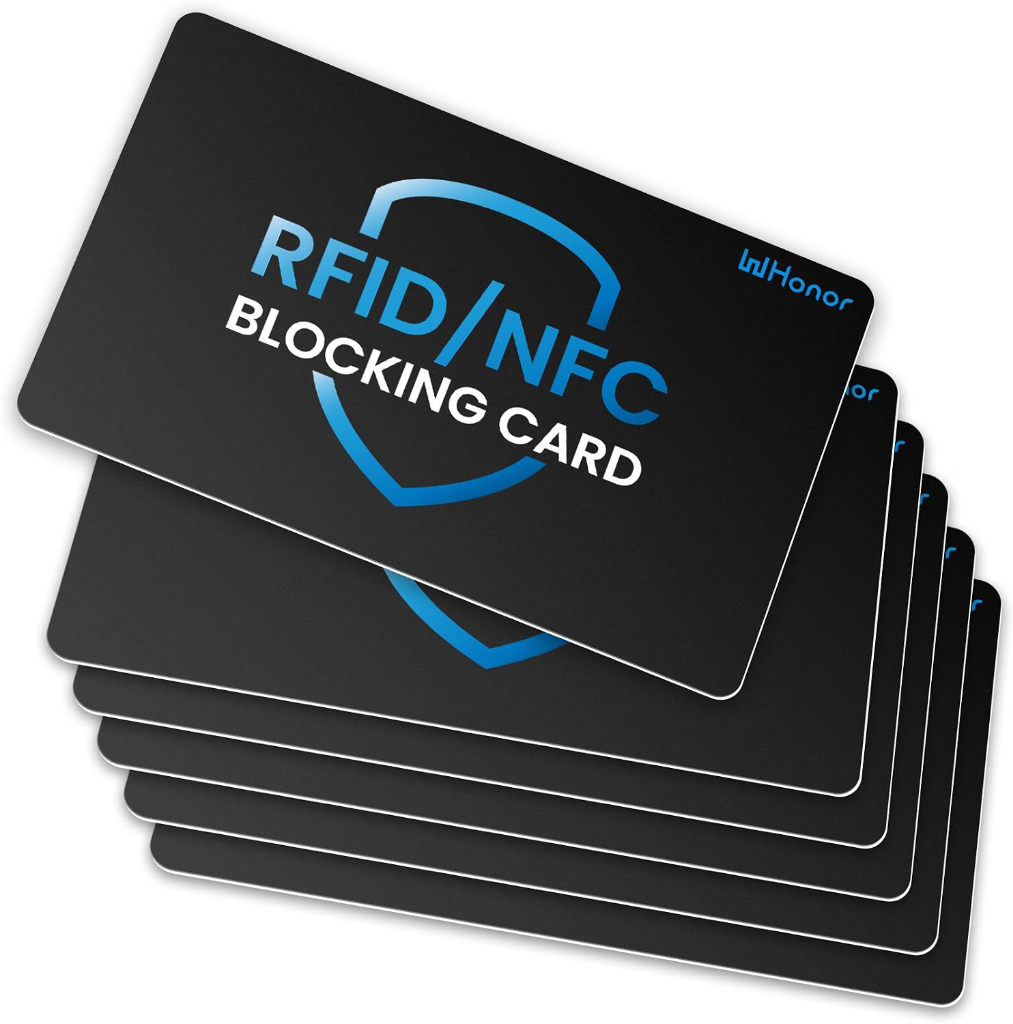
WHonor RFID Blocking Card (6-Pack)
A PVC card, 0.03" thick, sold in packs of 1 to 20. WHonor's own listing describes "an embedded antenna mesh and chip that instantly detects and scrambles various signals" — active-jamming language, not simple passive shielding. The listing also includes its own suggested test: layer the card with a contactless card at a reader and confirm the payment fails.
The listing carries a "recycled materials" sustainability badge and leans on gift framing in its own bullets — positioned as a practical stocking-filler rather than a primary purchase. It's also commonly bundled with matching RFID sleeves for cards and passports in Amazon's "frequently bought together" placement, suggesting WHonor (or its distributor) sells across the sleeve and card formats rather than specializing in one.
Explicitly branded as a "jamming chip" — the listing states the antenna draws power from the incoming reader signal itself to power the chip, requiring no battery. It also states a specific effective range: 2.4 feet. That's the most precise distance claim found across every RFID product reviewed on this site — and, per the finding above, it's dramatically larger than a very similar product's claimed range.
SaiTech IT Private Ltd. states it's been operating since 2013, which is a genuine, checkable claim about the seller rather than the product's RFID performance — worth keeping that distinction clear, since a company's longevity says nothing about whether this specific card's 2.4-foot range figure is accurate. The card is also sold in an unusually wide spread of pack sizes, from a single card up to 50, suggesting this is a high-volume, frequently reordered product rather than a one-off purchase for most buyers.
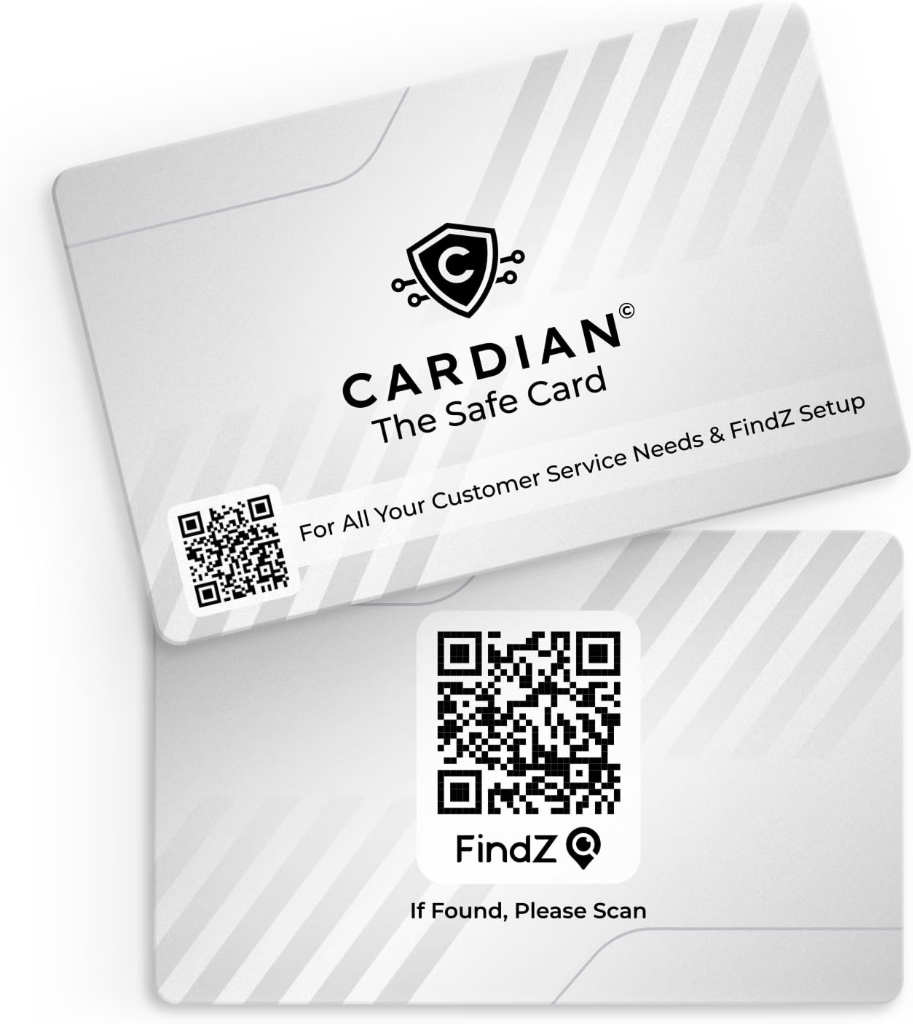
The most expensive of the five by a wide margin — roughly $11 per card, versus $1–2 for the others — while making the vaguest claim of the group: "advanced smart NFC and RFID card blocking technology," no mechanism named, no figure of any kind. It does include a genuinely different feature: a printed QR code that links to a "scan if found" registration service, useful if the card (or the wallet it's in) gets lost.
Amazon's own "frequently bought together" placement sells this card alongside a travel bidet, a 3-in-1 telescope, and a hunting monocular — all fulfilled by the same distributor, "SavvySmartDeals." That's a useful bit of context: this reads as a general dropship/import catalog rather than a company specializing in RFID protection specifically, which lines up with the vaguer, less mechanism-specific claim on the listing compared to WHonor, SaiTech, or Blackout.
WHAT WE LIKE
QR-code "if found" registration, genuinely different
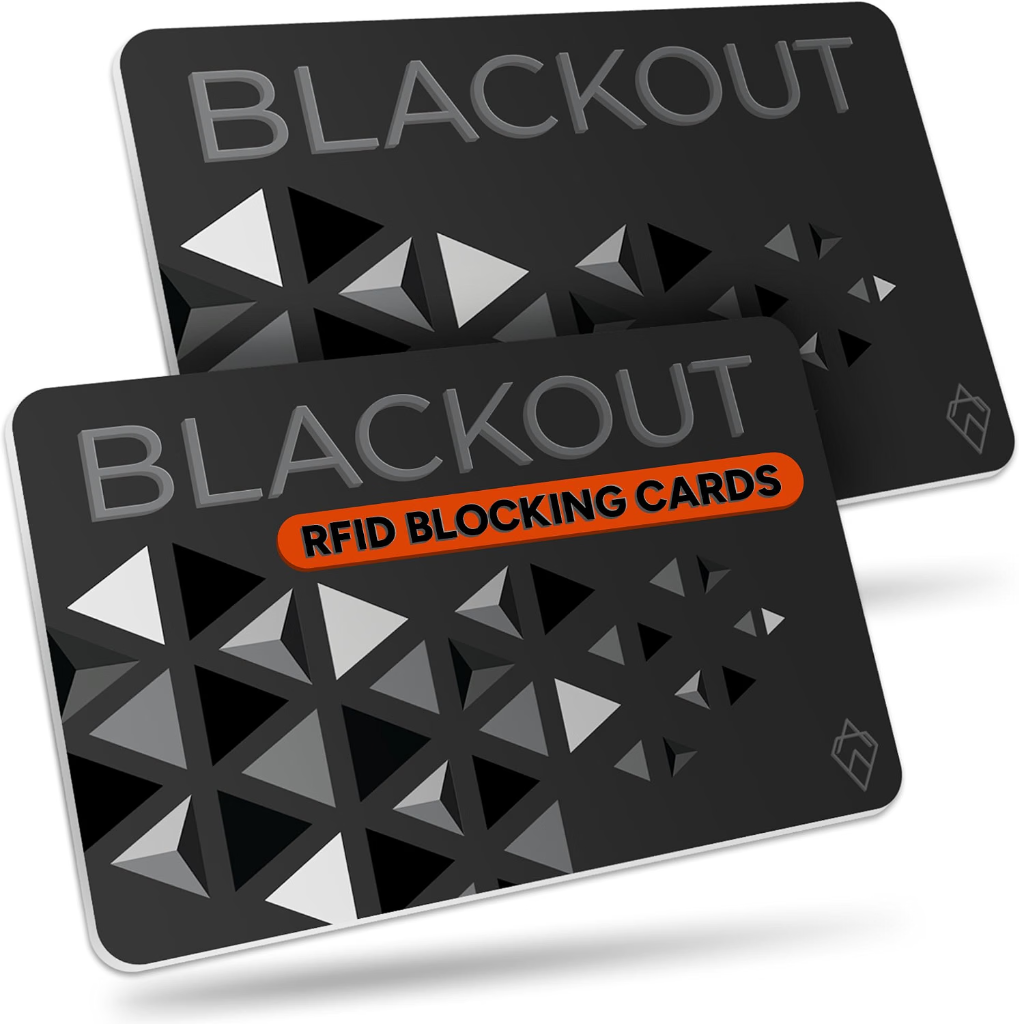
Also an explicit "micro-jamming technology" claim — "an advanced processor and antenna specifically programmed to scramble and block" — energy-harvested from the reader, no battery, same general concept as SaiTech. Where it differs sharply is the claimed range: 10cm total (5cm on each side of the card), a small fraction of SaiTech's 2.4-foot claim for what's described as the same underlying mechanism.
One line in the listing is worth flagging on its own: "unlike other card protectors, we use a processor chip that we KNOW others don't use." That's a comparative claim against unnamed competitors with nothing to verify it — no named competitor, no test, no way to check whether it's true. It sits alongside the 10cm range figure as another example of confident-sounding specifics that don't actually hold up to a "how would we check this" test.
WHAT WE LIKE
Cheapest per-card price of the five
10cm claim is more physically plausible
Includes its own self-test instructions
WATCH FOR
Still an unverified manufacturer figure
"Twice the strength" comparison unstated
QUICK SPECS
Material: RFID blocking chip (processor + antenna)
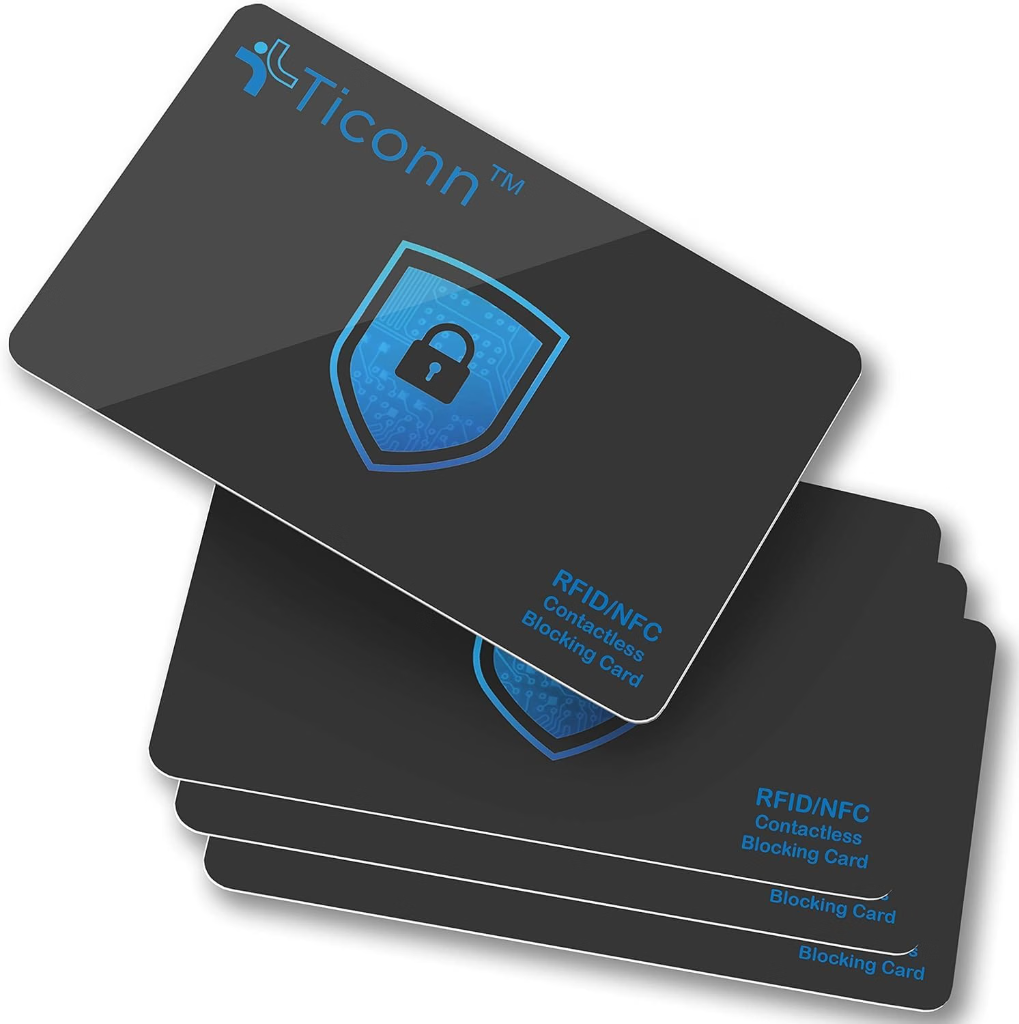
Genuinely different from the other four: TICONN describes "an electromagnetically opaque layer" that shields nearby readers — passive language throughout, no claimed processor, antenna, or energy harvesting. "No charging, no setup" is consistent with a simple passive shield rather than an active component. This is the most conservative, least dramatic mechanism claim in the batch — which, per this site's whole approach, is not a bad thing.
TICONN's own product page cross-sells a Faraday bag further down the listing, meaning the brand operates across both the RFID-card and Faraday-bag categories rather than specializing in one — worth knowing if TICONN comes up again when this site eventually covers Faraday bag brands. Amazon also surfaces WHonor's card directly as a "similar item" on TICONN's own page, which is a reasonable indicator that shoppers treat these two products as close substitutes despite their different mechanism claims (passive shielding vs. active jamming).
Editorial Note // Active Jamming Claims vs. Passive Shielding
Standalone blocking cards generally divide into two engineering approaches: passive conductive barriers that attenuate magnetic coupling, and active “jamming chips” that harvest energy from an incoming 13.56 MHz reader to broadcast interference. While energy harvesting is a genuine electromagnetic concept, claims of multi-foot active scrambling from an unpowered card contradict near-field inductive physics. A card specifying passive shielding (like TICONN) or a modest 5–10 cm zone (like Blackout) is substantially more consistent with physical reality than multi-foot jamming promises.
What is an RFID blocking card?
Three genuinely different product types get discussed under this umbrella, and they don’t work the same way:
Blocking card — placed alongside your other credentials in a wallet, rather than enclosing any one of them.
RFID wallet — shielding integrated into the wallet’s own construction, such as a metal or lined billfold (covered in our RFID wallets guide).
RFID sleeve — a credential physically enclosed inside shielded material, like individual credit card sleeves (covered in our RFID sleeves guide).
Don’t assume a product described with any of these terms works identically to another just because they’re all filed under “RFID blocking.”
How do RFID blocking cards work?
This depends entirely on product design, and it’s worth being honest that PrivacyLabz hasn’t independently verified every mechanism claimed across this category. In general terms, RFID shielding works by placing conductive material between a reader and a credential, interfering with the field strong enough to prevent the credential from powering a response — the same principle covered on the RFID Blocking pillar. Some blocking-card products describe this mechanism plainly; others use vaguer language about “interference” or “signal scrambling” without clearly explaining what’s actually happening. A blocking card is easy to understand as a product. The physics can be a little messier, especially once you’re asking a single card-sized object to protect several other cards around it rather than enclosing just one.
There’s a real geometric problem worth understanding here, separate from whatever material a product uses. A wallet is a stack — cards sit next to each other, not neatly separated by distance. A blocking card placed at one end of that stack has a fundamentally harder job than a sleeve wrapped fully around a single card, because it’s trying to interrupt a field from one side rather than enclosing the target credential on every side. This isn’t a reason to dismiss the category — some products are genuinely designed and positioned to address this — but it’s a reason “how many cards can it protect” isn’t a question with an obvious universal answer, and why placement instructions matter more for this product type than for a sleeve or a wallet with continuous shielding built around its whole interior.
Do RFID blocking cards actually work?
Not a blanket yes or no. Performance depends on operating frequency, the specific product’s mechanism, its position relative to the cards it’s meant to protect, how many cards are in the wallet, reader strength, wallet geometry, and orientation. A product preventing one particular reader from reading one particular card in one particular test setup is a real, useful data point — it doesn’t establish universal performance across every wallet configuration a buyer might actually use. This is the same distinction covered throughout this site between a functional test and laboratory RF characterization: one tells you something worked once, under those conditions; the other quantifies performance in a way you can actually compare across products.
Claim Check
“2.4 feet of active jamming range”
Three products in this evaluation (WHonor, SaiTech, Blackout) claim a battery-free jamming chip that harvests energy from an incoming reader signal to actively scramble communication. While RF energy harvesting is a genuine principle used in passive RFID tags, the two products that quantify their effective range disagree by roughly 7x: SaiTech claims 2.4 feet (approx. 73 cm), while Blackout claims 10 cm total (5 cm on each side). Two products claiming the identical underlying mechanism cannot physically produce distance figures an order of magnitude apart if either were derived from standardized laboratory measurements. An unpowered passive antenna cannot harvest sufficient inductive energy from a standard 13.56 MHz payment terminal to generate a 2.4-foot active interference field. When two products claiming the same technology offer conflicting quantified metrics, the figures represent unverified marketing assertions rather than measured physical performance.
How to use an RFID blocking card
Identify the product type first — confirm it’s actually a standalone blocking card, not a wallet or sleeve being described loosely with the same language.
Check the manufacturer’s placement instructions — some products require specific positioning relative to the cards they’re meant to protect.
Position it as instructed, not just anywhere in the wallet that seems convenient.
Test the configuration with a compatible contactless reader where appropriate.
Don’t assume one test proves everything — a single successful check under one condition doesn’t establish performance across every reader, orientation, or wallet arrangement you might use. If the instructions require the card to sit in a particular position, throwing it somewhere into a wallet and hoping for the best isn’t much of a test.
What matters when choosing an RFID blocking card?
When comparing options or evaluating marketing claims, seven core engineering and practical factors determine whether a product offers genuine utility:
01 // FREQUENCY
Supported frequency
What does the manufacturer actually specify — a real frequency like standard 13.56 MHz, or just “signal blocking” with nothing attached?
02 // MECHANISM
Mechanism
How is the product supposed to interfere with communication (conductive passive barrier or active field disturbance), and is that explained at all?
03 // PLACEMENT
Placement requirements
Where does it need to sit relative to your other cards for it to do anything? Center of the stack, outer perimeter, or flanking both sides?
04 // COVERAGE
Tested coverage
Is it meant to protect one credential, several, or the whole wallet — and is that claim supported by specific test parameters or vague assertions?
05 // PROFILE
Thickness and bulk
Does adding it make the wallet annoying to actually use day to day? Rigid cards or battery-powered inserts consume valuable card-slot depth.
06 // VERIFICATION
Testing evidence
Does the manufacturer provide any meaningful technical evidence or third-party laboratory data, or just broad marketing adjectives?
07 // LONGEVITY
Durability
Does bending, pocket compression, or everyday friction wear affect a thin card-format product differently than a rigid wallet or a simple sleeve?
Blocking card vs. RFID wallet vs. RFID sleeve
Each form factor approaches contactless credential defense from a distinct physical architecture, with different daily usability trade-offs:
Dimension
Blocking Card
RFID Wallet
RFID Sleeve
Physical Format
Credit-card-sized insert that slips into an existing wallet slot.
Complete wallet with conductive mesh or metallic plates built into the chassis.
Individual paper or synthetic foil pouch sized for a single card or passport.
Pros
Convenient, card-sized, allows keeping your current wallet; may cover multiple nearby credentials depending on design.
Shielding built directly into the wallet structure; no separate loose insert required; continuous coverage for all interior slots.
Physically surrounds one specific credential completely; simple, transparent physical shielding concept; zero moving parts.
Limitations
Mechanism and coverage vary substantially by product; placement relative to other cards in the stack matters critically.
Bulk and design vary; shielding implementation varies by manufacturer; requires replacing your everyday carry wallet.
Each credential generally needs its own sleeve; adds friction when pulling cards out for frequent access at checkout.
Best For
Someone satisfied with their current unshielded wallet who wants added shielding without replacing it.
Someone starting from scratch or already looking for a new everyday carry minimalist or bi-fold wallet.
Someone protecting one specific item (like a passport, covered on our passports page) rather than an entire wallet.
None of these is universally better — a blocking card suits someone who doesn’t want to change wallets, an RFID wallet suits someone starting from scratch on their everyday carry, and a sleeve suits someone protecting one specific item rather than an entire wallet.
Do you actually need an RFID blocking card?
Worth separating two different questions, same as elsewhere on this site: does the technology work, and how large is the real-world threat it’s addressing? Contactless payment systems already have security mechanisms beyond simply broadcasting card information openly to anything nearby — this isn’t a wide-open vulnerability that a blocking card is the only thing standing between you and fraud.
Modern EMV contactless cards utilize cryptographic dynamic authentication (one-time cryptograms). Even if a rogue terminal powers the card chip over 13.56 MHz, it cannot extract the physical three-digit CVV security code on the back, nor can it clone the magnetic stripe data or capture the private encryption keys stored inside the secure element.
Crucially, RFID blocking, in any form, does not prevent:
Online card fraud resulting from database leaks or intercepted ecommerce checkout sessions.
Compromised merchants or malicious physical card skimmers attached to point-of-sale terminals or ATMs.
Stolen credentials obtained via phishing or credential-stuffing campaigns.
Physical card theft where the card is physically taken from your possession.
Core Principle
Blocking a radio signal is not the same thing as blocking card fraud generally.
The two are related only at the narrow edge where proximity RFID reading specifically is the mechanism in question, and that’s a smaller slice of actual card fraud than product marketing in this category tends to imply.
Where a blocking card genuinely earns its place: you don’t want to replace your current wallet, but you’d still like some added shielding without changing your everyday carry. That’s a real, reasonable use case, distinct from the fear-based framing a lot of listings lean on.
Where it’s less clearly necessary: if you’re starting from scratch anyway, an RFID wallet or an individual sleeve around your most-used card may give you more predictable, easier-to-understand coverage than trying to position a separate card correctly every time you reorganize your wallet.
What about an RFID blocking card holder?
This term gets used to mean several different things, and it’s worth untangling rather than assuming. Someone searching this might mean an RFID-blocking wallet (such as the rigid aluminum card cases in our RFID wallets guide), a metal card holder generally, an individual sleeve, or literally a holder designed to carry a standalone blocking card. If what you’re actually looking for is a wallet with shielding built into its construction — which is what a lot of this search phrase’s traffic likely wants — explore RFID-blocking wallets rather than assuming a “blocking card holder” and a “blocking card” are the same purchase decision.
Frequently asked questions
Do RFID blocking cards actually work?
Some products can interfere with compatible RFID/NFC communication under specific conditions, but performance varies by mechanism, placement, and configuration — not a blanket guarantee across the category.
How do you use an RFID blocking card?
Confirm the product is actually a standalone blocking card, follow the manufacturer's placement instructions exactly, and test the actual configuration you'll be using rather than assuming any placement works.
How many credit cards can one RFID blocking card protect?
There's no universal number — this depends entirely on the specific product's mechanism and tested configuration, and should be a claim the listing actually specifies rather than one you assume.
Is an RFID blocking card better than an RFID wallet?
Neither is universally better — a blocking card lets you keep your current wallet, while an RFID wallet integrates shielding into a new one. The right choice depends on whether you want to change wallets at all.
Do RFID blocking cards stop NFC?
NFC operates in the same general frequency range (13.56 MHz) as most RFID payment cards, so a product genuinely shielding that frequency would affect both — but this depends on the specific product actually covering that range, not assumed by default.
What is the best RFID blocking card?
There isn't one universal best — suitability depends on mechanism, your wallet configuration, supported frequencies, and what you're actually trying to protect. See the products section above for specific options representing different approaches.
Authoritative Technical Literature & Sources Used
The Ridge, Official Product Specifications:Ridge Wallet 2.0 Architectural Documentation — Supports: 6061-T6 aluminum and anodized plating construction, dual-track elastic retaining 1–12 cards, integrated metal chassis RF shielding.
Rogue Industries, Official Product Data:WalletGuard Credit Card Sleeves Technical Specifications — Supports: WalletGuard nano-thin metal foil laminate, manufacturer-stated FIPS 201 testing at 13.56 MHz, 3.4" x 2.3" dimensions.
PrivacyLabz Research Foundation:RFID Blocking: The Complete Guide — Cross-referenced for near-field 13.56 MHz inductive coupling physics, skin depth calculations, and functional vs. laboratory RF characterization.
NIST FIPS 201-3 Standards:Personal Identity Verification (PIV) of Federal Employees and Contractors — Electromagnetic attenuation criteria for contactless smart card shielding containers.
Editorial Fact-Check Notes: Products #1, #4, and #5 are unpopulated placeholders — no standalone RFID blocking card product was verified this pass. Rogue’s FIPS 201 testing is cited from the manufacturer’s official specification without an independently linked laboratory test report, and is presented as a manufacturer claim per PrivacyLabz standards.
Explore RFID Protection
Navigate our practical guides across each shielding category: