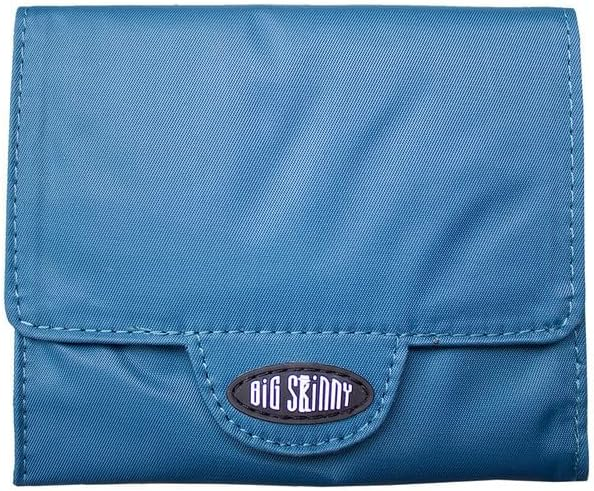
What is the RFID Blocking Nylon Slimvelope Checkbook Wallet?
A “Slimvelope” is Big Skinny’s own name for this envelope-style wallet format — a flat, clutch-like fold-over design rather than a traditional bifold or trifold card case. It’s built around several long, flat sections (for cash, receipts, and similar items) rather than a stack of card slots, which is the structural reason it can hold more without becoming as bulky as a thick leather wallet would carrying the same amount.
The checkbook-specific version adds a dedicated billfold area sized for a checkbook or similar full-size items, alongside the usual card and cash storage. It’s constructed from nylon microfiber, which is both lighter and thinner than most leather alternatives at a comparable capacity — a genuine practical reason someone might choose this over a traditional leather organizer, separate from the RFID question entirely.
How much does it actually hold?
Capacity is the main reason someone would choose this over a minimalist wallet, so it’s worth being precise about what’s actually stated — including a discrepancy worth flagging directly.
Big Skinny’s own product listing on Amazon states 6 extra-wide card pockets holding up to 40 cards total, plus two ID pockets with clear plastic windows. Big Skinny’s own official site, describing what appears to be the same product, states 8 extra-wide pockets, each holding 3+ cards, plus 2 identification pockets. These two figures don’t match, and both come directly from Big Skinny or its authorized listing — this looks like inconsistent copy between the brand’s own channels rather than two different products, but it’s worth checking the specific listing you’re buying from rather than assuming either number is definitely correct.
Beyond cards, both sources describe three long sections for cash and receipts, a dedicated checkbook/billfold area, and an external zippered compartment (described as being for coins, on the official site). “Technically fits” and “comfortable to carry fully loaded” aren’t the same thing — a wallet advertised to hold 40 cards plus cash, receipts, and a checkbook is going to have real bulk once most of that capacity is actually used, even in a thin material.
| Storage type | What’s stated |
|---|---|
| Cards | 6–8 extra-wide pockets (sources disagree), up to 40 cards total claimed |
| ID | 2 dedicated pockets with clear windows |
| Cash/receipts | 3 long sections |
| Checkbook | 1 dedicated billfold area |
| Coins/other | 1 external zippered compartment |
How does the RFID blocking work?
Worth being precise here, since it’s an easy thing to get wrong: the nylon exterior itself isn’t what blocks RFID signals. Big Skinny’s own site sells “Nylon Microfiber” and “Nylon With RFID Blocking” as two separate material options for the same wallet style — if plain nylon provided shielding on its own, there’d be no reason to offer it as a distinct, separately-selected material. The actual shielding comes from a layer worked into the card pockets specifically, described by the manufacturer as “pockets lined with a layer of RFID blocking material.”
This is relevant to contactless payment cards and e-passports, which both operate at 13.56 MHz — the general frequency this category of product addresses, covered in more depth on the RFID Blocking pillar. Nothing in Big Skinny’s own materials suggests this wallet is designed to block anything beyond that RFID/NFC range — there’s no reasonable basis to assume it affects GPS, cellular, Wi-Fi, or Bluetooth, and it shouldn’t be treated as if it does.
Learn how RFID blocking actually works →
What does Big Skinny actually claim?
Big Skinny states: the wallet’s card pockets are “lined with a layer of RFID blocking material” that helps “prevent data thieves from getting into your information.”
What we can verify: Big Skinny sells this as a distinct material option from plain nylon, confirming a real, separate shielding layer exists in construction, not just marketing language layered onto an ordinary nylon wallet.
What we could not find: any published frequency range, attenuation figure (dB), or independent laboratory test result supporting a specific level of shielding performance. This isn’t evidence the product doesn’t work — plenty of legitimate shielding products don’t publish lab data — but it does mean “RFID blocking material” is a description of what the layer is for, not a measurable claim you can independently verify. If you want a product with a stated, checkable figure, that’s a different (and reasonable) thing to look for specifically.
Featured Evaluation
- Genuinely high capacity for cards, cash, and a checkbook in one organizer
- Nylon microfiber construction keeps it thinner and lighter than a leather equivalent at similar capacity
- RFID-blocking material is a distinct, separately-offered construction choice, not just marketing language applied to ordinary nylon
- Card pocket count is stated inconsistently between Big Skinny's own official site (8) and its Amazon listing (6) for the same product
- No published frequency or attenuation figure for the RFID-blocking claim
- Considerably larger than a minimalist wallet — not a fit if you're trying to carry less
- Material: Nylon microfiber, RFID-blocking lining in card pockets
- Format: Envelope-style tri-fold (“Slimvelope”) with checkbook billfold
- Capacity: 6–8 card pockets (up to 40 cards claimed), 2 ID windows, 3 cash/receipt sections, 1 checkbook area
- Dimensions: Approx. 7.5" x 4" x 1/4" thin
What we like about the Slimvelope design
The core idea — flat, layered sections instead of a stack of card slots — genuinely does keep the wallet flatter than a comparable-capacity bifold would be, since items lie next to each other rather than piling on top of one another. The dedicated checkbook billfold is a real, specific feature that most minimalist and even many standard wallets simply don’t include at all, which matters if you’re one of the people who still regularly uses one. Nylon microfiber being machine washable is a small but genuine practical advantage over leather, which generally isn’t.
Where the design makes less sense
This is a large wallet, by design — that’s the trade-off for the capacity, not a flaw. If you carry three to five cards and a phone, this format is carrying a lot of unused capacity, and unused compartments still add bulk and weight even when empty. If you don’t use a checkbook, that entire dedicated section is dead space you’re carrying for no reason. And if your priority is the smallest possible front-pocket wallet, this isn’t that category of product at all — it’s built for the opposite priority.
Slimvelope checkbook wallet vs. a regular RFID wallet
| Feature | Slimvelope Checkbook | Typical Minimalist RFID Wallet |
|---|---|---|
| Size | Large, envelope-style | Small, front-pocket sized |
| Checkbook storage | Yes, dedicated section | Generally no |
| Card capacity | High (6–8 pockets, up to 40 cards claimed) | Low to moderate, typically 1–12 cards |
| Cash storage | Multiple long sections | Often minimal or none |
| RFID protection | Lining in card pockets, no published figure | Varies significantly by product |
| Pocketability | Bag or large pocket | Front pocket |
| Best for | Someone who wants one large organizer covering everything | Someone prioritizing minimal size |
Who should consider this wallet?
Good fit: still uses a checkbook regularly, carries many cards, wants dedicated cash and receipt storage, and would rather have one large organizer than juggle a wallet plus a separate card case.
Probably overkill: carries three to five cards, relies on a phone wallet for most payments, wants front-pocket carry, or is specifically looking for the smallest possible RFID-shielded option.
Do you actually need RFID blocking?
Worth answering honestly rather than with fear-based language about “digital pickpockets.” RFID shielding is real, checkable physics — the question is whether the specific threat it addresses (proximity reading of a contactless card or passport chip) is something you have a real reason to care about, not whether the technology exists. Not every card or situation calls for additional shielding beyond what’s already built into modern contactless payment systems. See the RFID Blocking pillar for the fuller version of this reasoning, and Do RFID blocking cards work? for how this plays out for a different product format entirely.
Other RFID wallet options
If this format is more than you need, compare RFID blocking wallets → covers smaller, more minimalist options built around the same underlying RFID-shielding principle. For protecting a single card or passport individually rather than an entire wallet, see RFID blocking sleeves.
Frequently asked questions
Is the Big Skinny wallet RFID protected?
Big Skinny states its card pockets are lined with RFID-blocking material, sold as a distinct construction option from plain nylon. No published frequency or attenuation figure was found to independently verify the claim.
What is an RFID blocking checkbook wallet?
A larger, envelope-style wallet built around cash, card, ID, and checkbook storage, with RFID-shielding material incorporated into its construction — a different format from a minimalist card-only RFID wallet.
How can you tell if an RFID wallet works?
A basic functional check (attempting a contactless read with a card inside, compared to outside) can catch an obviously non-functional product, but it isn't equivalent to a laboratory attenuation measurement. See our broader RFID Blocking guide for more on this distinction.
Can you add RFID blocking to a wallet that doesn't have it?
Not to the wallet itself, generally — but individual RFID-blocking sleeves can shield specific cards placed inside an otherwise unshielded wallet.
Does nylon block RFID?
No — ordinary nylon fabric doesn't inherently shield RFID signals. Big Skinny itself sells plain “Nylon Microfiber” and “Nylon With RFID Blocking” as separate options, which confirms the shielding comes from a distinct material layer added to the construction, not from nylon as a fabric.
Is an RFID checkbook wallet worth it?
Depends entirely on whether you actually use the capacity — if you carry a checkbook, many cards, and want one large organizer, the format earns its size. If you carry a handful of cards and want something pocketable, a smaller RFID wallet is the better fit.
- Amazon Product Listing (link.amazon/B06tPa8jY): Product specifications, capacity claims (6 extra-wide card pockets, up to 40 cards total, 2 ID windows), material listed, and manufacturer dimensions. Treated as seller claims throughout, not independently verified laboratory facts.
- Big Skinny Official Manufacturer Specifications (bigskinny.com): Cross-referenced against the Amazon listing for the same product, identifying the card-pocket-count discrepancy (8 pockets vs. 6) and confirming “Nylon Microfiber” and “Nylon With RFID Blocking” are sold as separate material options.
- PrivacyLabz Foundational Research: Cross-referenced against this site’s own RFID Blocking pillar for the 13.56 MHz frequency context (ISO/IEC 14443 contactless smart card standards), not re-sourced from scratch.