- What it does: Temporarily isolates a phone from wireless communication when the enclosure provides sufficient shielding and is properly closed.
- Commonly targeted: Cellular, Wi-Fi, Bluetooth, and GNSS/GPS reception.
- Best for: Situations where physical radio isolation is genuinely useful — not a general privacy upgrade for daily use.
- What matters: Shielding performance, closure, fit, and evidence supporting the product’s claims.
- Biggest misconception: A Faraday bag doesn’t erase data, remove malware, or permanently make a phone untrackable.
What happens when you put a phone in a Faraday bag?
Cellular. With sufficient attenuation, the phone loses its connection to the cellular network — incoming calls don’t reach it, and outgoing calls or data can’t be sent.
Calls. Here’s where it’s worth being precise: if the phone isn’t receiving the cellular signal, an incoming call typically goes to voicemail rather than ringing. But the caller hearing a ringing tone isn’t proof the enclosed handset is actually receiving anything — ringback tones are generated by carrier network signaling, not a direct real-time mirror of what the destination device is doing. Don’t treat what you hear as the caller as definitive; check the enclosed phone directly once it’s out (missed call notification, voicemail) for a real answer.
Messages. SMS and internet-based messages sent while the phone is unreachable typically queue and arrive once it reconnects, rather than being lost — being sealed in a bag delays the phone’s awareness of them, it doesn’t erase them.
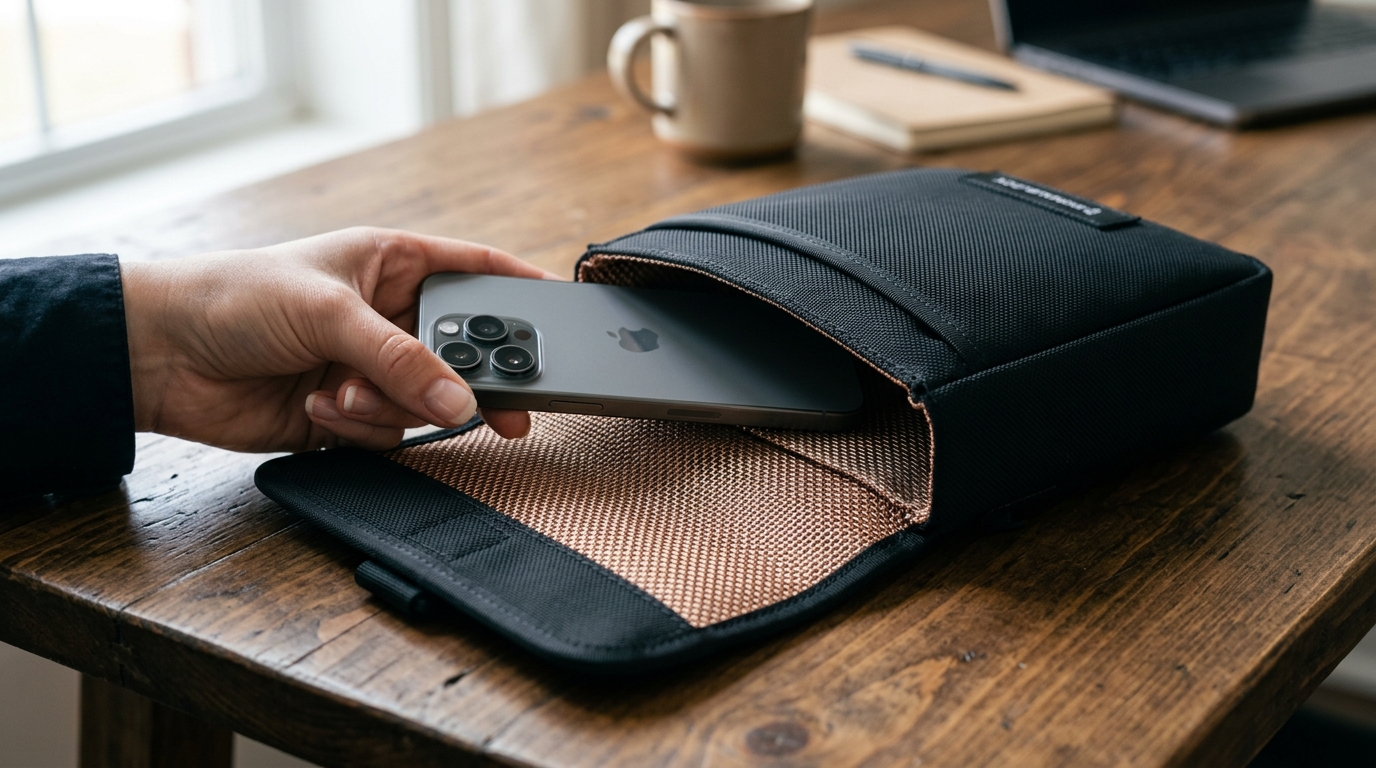
Wi-Fi and Bluetooth. Both drop the same way cellular does, with sufficient attenuation — connected accessories disconnect, and app sync or cloud-based notifications stop updating until the phone reconnects.
GPS/GNSS. This needs care, because it’s easy to draw the wrong conclusion here. Satellite navigation reception isn’t the same thing as cellular tracking, and a phone can continue to display location-related information for reasons that don’t mean it’s currently receiving a live GNSS signal — a recently cached position, network-based positioning from before the phone was sealed, or a maps app showing stored data can all look similar to “the phone still knows where it is” without an active satellite fix. Don’t conclude a bag failed just because a location dot doesn’t move instantly.
Apps and local functions. A phone in a Faraday bag doesn’t simply stop working — it’s the distinction between network communication and local device function that matters. The clock keeps running, alarms still fire, and anything already downloaded (offline maps, saved documents) still works. What stops is anything requiring an active connection to something outside the phone.
What signals are Faraday bags for phones designed to block?
| Signal | What the phone uses it for | What the bag needs to do |
|---|---|---|
| Cellular | Calls, SMS, mobile data | Attenuate across relevant cellular bands (2G–5G sub-6GHz) |
| Wi-Fi | Internet, app sync | Attenuate at 2.4 GHz and 5 GHz |
| Bluetooth | Accessories, Find My–style networks | Attenuate the 2.4 GHz ISM band |
| GNSS/GPS | Live location, navigation | Attenuate around 1.575 GHz (GPS L1) |
| NFC | Contactless payment, tap-to-pair | Attenuate at 13.56 MHz |

None of these are universally “blocked” simply because a product is marketed as a Faraday bag — being labeled one doesn’t itself prove adequate shielding across every relevant frequency. Actual coverage is product-specific, covered in more depth in What do Faraday bags block?
Can a phone still be tracked inside a Faraday bag?
If the bag is genuinely attenuating the relevant signals, live radio communication stops while it’s sealed — but that’s narrower than “untraceable.” Data already collected before the phone went in the bag, locally stored information, and whatever happens once the phone reconnects are all separate from the live-isolation window a working bag provides. “A Faraday bag makes your phone untraceable” overstates this — it creates a real window of isolation, not a permanent, retroactive guarantee. The fuller explanation, including a specific and genuinely useful detail about some phones retaining limited broadcast capability even when powered off, is in Can a phone be tracked inside a Faraday bag?
Faraday bag vs. airplane mode
| Attribute | Airplane Mode | Faraday Bag |
|---|---|---|
| What it is | Software-controlled radio configuration on the device | Physical shielding external to the device |
| Reliability | Varies by device/OS; Wi-Fi and Bluetooth can be manually re-enabled while it’s otherwise on | Doesn’t depend on the phone’s software state |
| Can you still use the phone | Yes, partially | No — it’s sealed |
Exact behavior varies enough across devices and OS versions that a universal statement about “what airplane mode disables” isn’t reliable — the fuller comparison, including why that inconsistency matters, is in Airplane mode vs. Faraday bag
Why would you use a Faraday bag for a phone?
Legitimate reasons include deliberate temporary wireless isolation, storage or transport of a device that doesn’t need to stay reachable, and specific privacy or security situations where physical radio isolation genuinely matters — including specialist/professional contexts like digital forensics, covered in more depth elsewhere on this site.
Where it’s probably overkill: for most ordinary phone use, physically isolating your phone throughout the day would be inconvenient without a specific reason driving it. Software controls, Do Not Disturb, or simply leaving the phone in another room accomplish most of what people actually want day-to-day, without needing a dedicated product. A Faraday bag earns its place for specific situations, not as a general daily habit.
What to look for in Faraday bags for phones
Fit. The phone needs to fit completely inside, including a case if you use one, without the device interfering with proper closure.
Closure. The closure is part of the shielding enclosure, not just a way to keep the phone from falling out — continuous contact along its full length matters more than any specific closure mechanism being universally “best.”
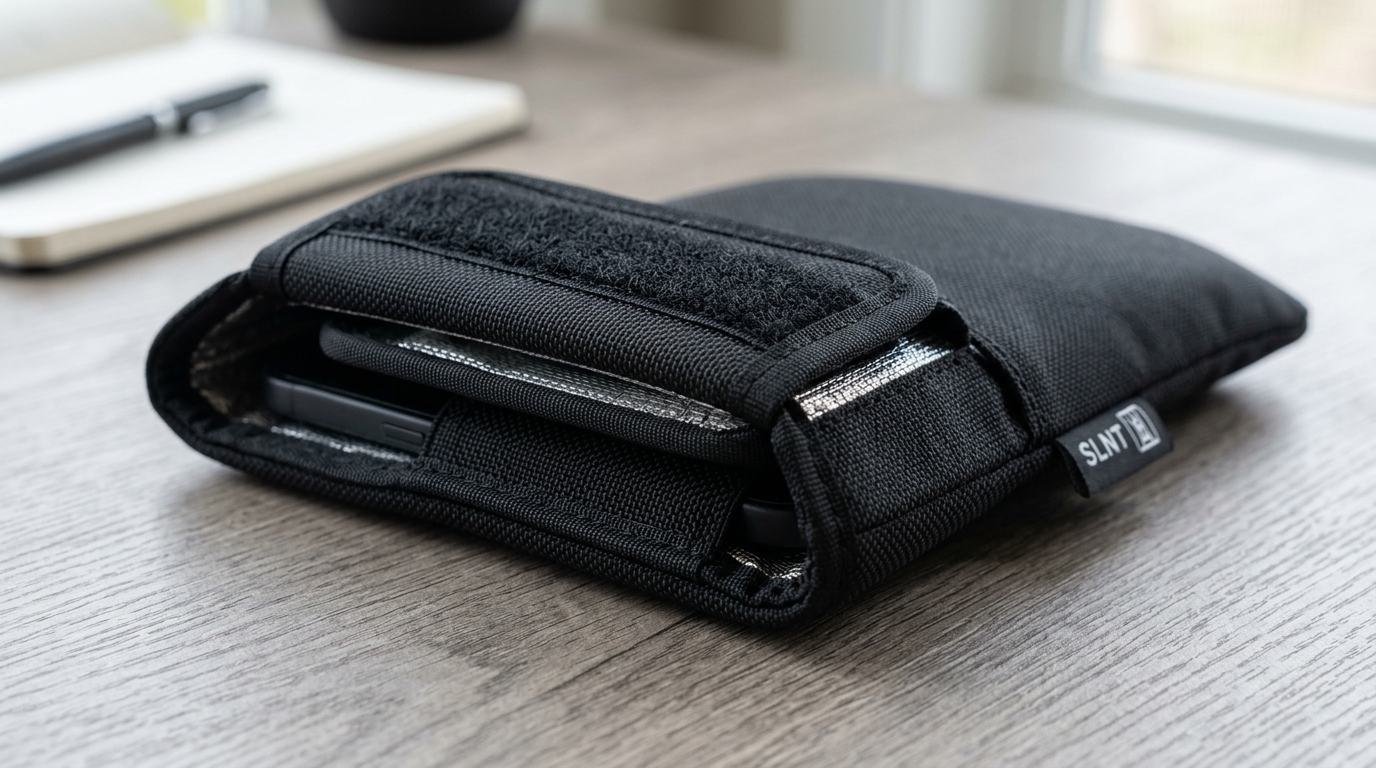
Shielding coverage. A manufacturer publishing a frequency range is telling you what they claim to cover — check that range actually includes the frequencies relevant to your intended use, not just an unspecified “blocks signals” claim.
Attenuation and dB. A larger attenuation figure sounds more impressive, but it needs context: at what frequency, under what test conditions, using what methodology? A number with none of that attached is closer to a slogan than a specification.
Testing evidence. There’s a real difference between a listing that says “signal blocking” and one that states a tested frequency range and attenuation measurement — the latter is something you can actually evaluate.
Construction. Conductive layering and material quality matter, but only claim what’s actually supported — avoid assuming a thicker-feeling fabric automatically performs better.
Durability. Repeated folding and closing is real mechanical stress on shielding fabric, covered in Do Faraday bags actually work? — but a lab study on textile degradation under controlled cycles isn’t the same as a guaranteed consumer-product lifespan, and shouldn’t be quoted as one.
Usability. A bag with excellent specifications that’s genuinely annoying to close correctly every time may be a worse everyday choice than a simpler one that actually gets used properly.
Size and portability. Single-phone pouches, larger phone-plus-accessory pouches, and multi-device bags all solve different problems — pick based on what you’re actually carrying, not the biggest or most feature-dense option available.
This sounds like a simple, reassuring claim, and it’s actually a much bigger one than it appears. Useful evidence needs context — which frequencies, what attenuation, what test method, under what conditions — since a product can genuinely perform differently across frequency ranges. That doesn’t mean every listing using this phrase is being dishonest; it means the phrase alone doesn’t give you anything to verify.
Faraday bags for phones worth considering
PrivacyLabz publishes product evaluations only when listings publish verified specifications or laboratory attenuation figures. Neither product has been physically tested by PrivacyLabz unless explicitly stated.
Evaluations in progress
Product candidate evaluations are in progress. In accordance with PrivacyLabz editorial policy, commercial recommendations are withheld until vendor listings provide independently verifiable laboratory attenuation data across cellular, Wi-Fi, Bluetooth, and GPS frequency bands.
How to test a phone Faraday bag
A basic functional check — seal the phone, call it from another line, see if it rings — can catch an obviously non-functional bag. But a failed cellular call doesn’t certify the bag’s shielding performance across every relevant frequency; it tells you about that one connection, under those conditions, nothing more. The full set of tests, including Wi-Fi, Bluetooth, and GPS-specific methods, is in How to Test a Faraday Bag at Home →
Why is my phone still ringing inside the bag?
A few likely explanations, roughly in order of how often they’re the actual cause: incomplete closure, the phone in the wrong compartment if the product has an unshielded storage pocket, the device itself interfering with the seal, worn or damaged shielding fabric, or the bag simply not providing adequate attenuation at your carrier’s specific frequency in that location. Worth repeating here since it matters: the caller hearing ringing isn’t proof the phone itself is receiving the call — check the phone directly once you retrieve it.
Do you actually need a Faraday bag for your phone?
Not necessarily. These are specialized tools, and for many ordinary users, physically isolating a phone from radio communication throughout the day would be genuinely inconvenient without solving a real problem they actually have. Physical isolation makes sense when you have a specific reason — travel through specific contexts, temporary device storage, a professional or security need for real certainty rather than a software setting’s probability. If none of that describes your situation, this isn’t something you need to add to your daily carry.
The bottom line
Faraday bags for phones are conceptually simple, but choosing one based on marketing language alone isn’t a reliable way to get a bag that actually works. What matters is fit, closure, relevant frequency coverage, evidence behind the shielding claims, usability, and honestly assessing whether you need physical radio isolation in the first place. Not sure which Faraday bag you need? Explore our Faraday bags overview guide →
Frequently asked questions
Do Faraday bags really work for phones?
The underlying physics is real and well-established — whether a specific bag performs as advertised depends on its construction, closure, and condition, covered in Do Faraday bags actually work?
Will my phone ring inside a Faraday bag?
Not if the bag is providing adequate cellular attenuation — the call should go to voicemail instead.
Does a Faraday bag block GPS?
A well-built one can, since GPS falls within the frequency range Faraday shielding generally attenuates — but as with any signal, actual performance is product-specific.
Does a Faraday bag block Wi-Fi?
Typically yes for a properly constructed bag, though it should be tested separately from cellular rather than assumed from a passed call test.
Does Bluetooth work inside a Faraday bag?
No, if the bag is genuinely attenuating that frequency — paired accessories will disconnect and the phone won’t be discoverable.
Can a phone be tracked inside a Faraday bag?
Not via live signal, if the bag is working — but that doesn’t erase data already collected beforehand. See Can a phone be tracked inside a Faraday bag? for the fuller picture.
Will my phone alarm still work inside a Faraday bag?
Yes — alarms run locally on the device and don’t need a network connection, so they’ll typically still sound, muffled by the enclosure.
Sources & Technical Literature
- “Faraday Cage” — Wikipedia. Fundamental shielding physics, electrostatic boundary conditions, and frequency-dependent skin depth.
- “Find My & Privacy” — Apple Support. Hardware-level Bluetooth beacon broadcasts persisting during low-power and powered-down device states.
- “Durability of Shield Effective Polyester Cotton Fabric...” — Polymers (Basel) / PubMed (2023). Measured attenuation degradation across conductive metallized textiles subjected to cyclic mechanical folding and abrasion.